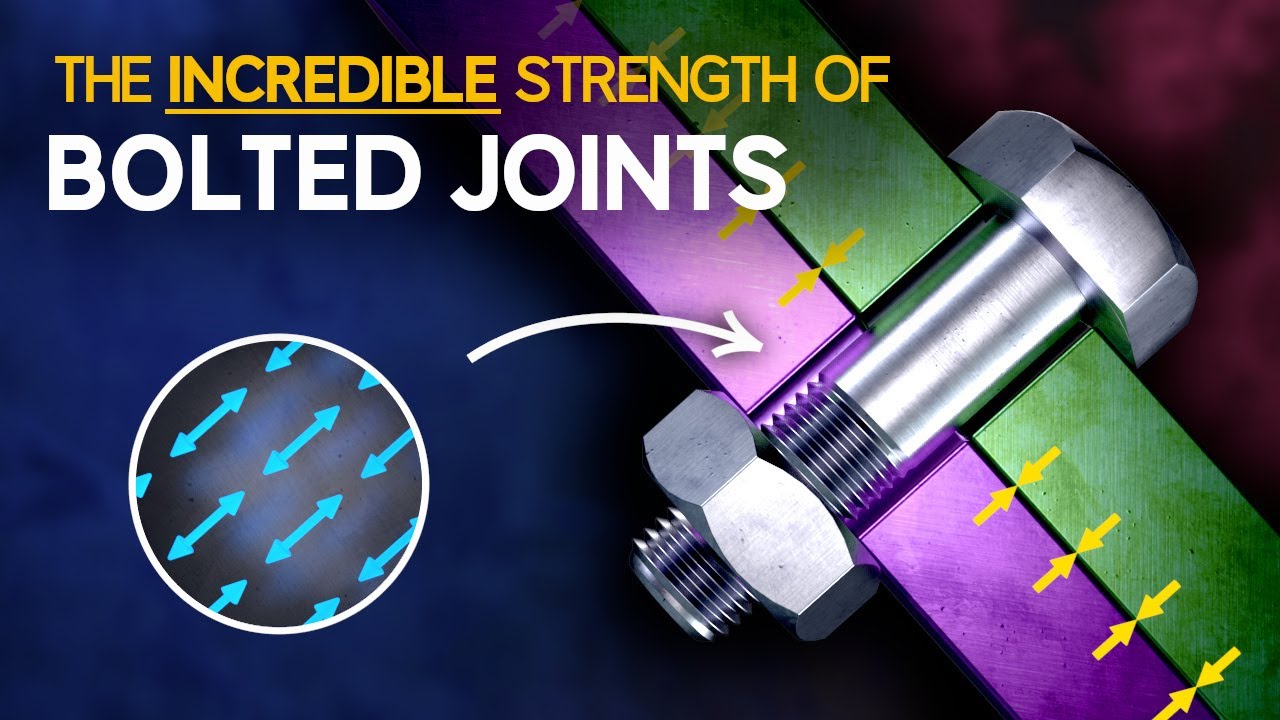
Bolt preload loss is a reduction in the clamp force created when a fastener was tightened. It can follow local embedment at the bearing faces or threads, time-dependent relaxation in a gasket or soft member, temperature changes, transverse slip, or vibration-induced rotation. These mechanisms are different and need different corrective actions. A nut that has not visibly turned can still lose preload as surfaces settle, while a nut that rotates is a distinct self-loosening event. Diagnose the mechanism before raising torque or adding a locking feature.
During tightening the bolt stretches elastically and compresses the clamped members. This initial tension creates preload. It keeps the faces together and can prevent separation or slip under service loads. The NASA Fastener Design Manual describes preload, joint stiffness, fatigue, installation variables, and fastener selection. The joint depends on the bolt, nut or tapped thread, washer, surface, member stiffness, and process together.
Preload is not identical to wrench torque. Torque is an indirect installation input affected by thread and bearing friction. Changing coating, lubricant, washer, or tool speed may change the starting clamp force, which can make a later “loss” look larger or smaller. See the torque-tension relationship guide and the fastener friction guide for those variables.

Embedment occurs when microscopic high points on contacting surfaces flatten under pressure. It can happen at the bolt head or nut bearing face, washer, threads, coatings, or member interfaces. A small amount of settlement can reduce elastic bolt stretch and therefore clamp force. Softer members, rough surfaces, thick coating stacks, and multiple interfaces can make it more important.
Relaxation and creep are time-dependent deformation. Gaskets, polymers, soft metals, composites, and some coatings may compress or flow under sustained load. Thermal changes can expand the bolt and members by different amounts, altering the force. These effects can occur without the nut rotating.
Vibration or transverse movement can cause self-loosening when the joint slips at an interface and relative motion rotates the fastener. Do not confuse this with relaxation. NASA’s study of preload relaxation in a thermal heat-strap assembly explains how material and thermal conditions can change a bolted joint over time. A separate NASA vibration-induced preload-loss investigation describes loss associated with nut-and-bolt unwinding. The examples involve specific hardware and should not be generalized into universal loss percentages.
| Mechanism | Typical clue | How to check | Design response to evaluate |
|---|---|---|---|
| Surface embedment | Early clamp-force decrease without visible nut rotation | Measure force after assembly and during initial service cycles | Review surface hardness, finish, washer, coating, and stack interfaces |
| Gasket or polymer relaxation | Force changes over time, often with temperature or compression | Monitor at defined times and service temperatures | Review gasket material, compression range, retightening policy, or joint design |
| Differential thermal expansion | Clamp force tracks heating and cooling | Measure through the actual temperature cycle | Analyze bolt and member materials, grip, and operating range |
| Transverse slip and rotation | Witness marks move, nut angle changes, or joint frets | Inspect marks and measure force before and after vibration exposure | Prevent slip, validate joint stiffness, and choose an appropriate locking strategy |
| Incorrect initial preload | Large variation across lots or tools from the first measurement | Correlate installation input with direct clamp-force data | Control friction condition, tool, sequence, and acceptance limits |
The table identifies diagnostic patterns, not unique proof of cause. Multiple mechanisms can act at once, and the test must reproduce the assembly and service condition.
Use a method that can observe force, fastener elongation, or a validated proxy. Options include an instrumented load washer, ultrasonic bolt elongation, strain measurement, or a representative fixture. Record an initial measurement after the specified seating procedure, then repeat at controlled times and after the relevant load, temperature, or vibration sequence.
Test production parts and keep the joint geometry, washer, coating, lubricant, tool, speed, and sequence consistent. ISO 16047 describes conditions for torque/clamp-force tests on covered fasteners; see the official ISO 16047 page and verify that the actual fastener falls within the standard’s scope. A torque audit after service is not automatically a direct measurement of original preload because breakaway friction and surface condition differ from installation.
Define the acceptable remaining clamp force from the joint function and loads. A percentage taken from another application may not be safe. For critical assemblies, evaluate minimum preload, separation, slip, fatigue, gasket sealing, electrical contact, and component strength using the governing design method.
Measure an initial baseline after the approved seating and dwell procedure. Repeat measurements at defined service intervals and after relevant operating events. Keep the same instrument setup, temperature condition, cable routing, and loading method so apparent change is not caused by the measurement system. For temperature-sensitive joints, record bolt and member temperatures with the force data and compare values at equivalent thermal states.
Torque audits need careful interpretation. Breakaway torque on removal includes the friction needed to start motion after the joint has aged, settled, corroded, or experienced vibration. It is not a direct reading of installed preload. A retightening check also changes the assembly and may hide the original state. Use the measurement method selected in the approved engineering plan and preserve the before-and-after record.
Address the observed cause. For embedment, examine flatness, hardness, roughness, washers, coatings, and number of contact layers. For relaxation, choose a suitable gasket or member design and set a validated service interval if retightening is permitted. For thermal change, analyze the actual material pair and temperature range. For vibration-induced rotation, establish whether the joint slips and then qualify a retention approach for the correct surface and environment.
Locking devices do not restore clamp force lost through a soft gasket or embedding surface. A locking nut or adhesive can resist rotation while preload still decreases. Choose locking features based on service conditions, material compatibility, reuse, temperature, and maintenance. The prevailing-torque nut guide compares one rotation-resistance approach.
This independent engineering explainer reviews preload and joint stiffness. It provides context for why a clamp-force change must be traced to the complete joint.

Define fastener standard, diameter and pitch, grade, material, finish, lubricant condition, nut or tapped-hole material, washer, grip, engagement, installation tool, sequence, target method, and any locking feature. For gaskets or soft members, include thickness, material, compression requirements, and whether retightening is allowed. Identify force or torque acceptance limits and how they will be verified.
In service, record assembly lot, tool calibration, torque or angle trace, date, temperature, and measured force if applicable. Changes to coating, lubricant, supplier, washer, gasket, or tightening equipment should trigger a review. TNHO’s bolt product family shows relevant fastener geometry; the quotation and approved drawing define the delivered part. The hex bolt grades guide gives an upstream reference for material strength designations.
For maintainable equipment, also specify which parts may be reused, whether a fastener is single-use, how lubricant is replenished, and when a joint must be replaced rather than retightened. A locking nut can resist rotation but does not restore preload lost through gasket creep. A spring feature may change force over travel but still needs a designed working range. Choose a corrective measure only after the observed loss mechanism is understood.
When a joint crosses a process boundary, define ownership of the baseline record. The supplier may control coating and lubricant, the assembler may control tool and sequence, and the service organization may record temperature or vibration events. A common part number without these conditions can conceal multiple friction systems and make preload trends difficult to compare.
During troubleshooting, change one variable at a time where practical. Compare the specified washer or gasket with a controlled alternative, or compare a production tool to a laboratory method, while keeping other conditions stable. This helps distinguish joint design effects from coating, handling, or tool variation.
Yes. Embedment, gasket relaxation, creep, and thermal effects can reduce elastic bolt stretch while the nut remains stationary. Measure clamp force or elongation to distinguish these mechanisms from rotation.
No. A lock nut can resist rotation, but it does not stop gasket compression, member creep, embedment, or differential thermal expansion. Validate the full joint under the service condition.
Only if the design, product procedure, and service instruction explicitly allow it. Retightening can improve force in some joints but may overload a fastener, damage a gasket, or disturb a qualified locking feature.
Use a suitable direct method such as an instrumented washer, ultrasonic elongation, or strain measurement, correlated to the actual joint. Breakaway torque alone is not a reliable measurement of the original clamp force.

 TNHO
TNHO