A hex bolt grade identifies a defined set of mechanical and material requirements under a particular standards system. It is not a universal strength ranking. SAE inch grades, ASTM specifications, and ISO metric property classes use different markings, test methods, diameter ranges, materials, and intended applications. A buyer who asks for “Grade 8.8” or converts Grade 8 directly to class 8.8 is mixing systems.
This guide provides a practical comparison while showing where a chart stops being safe. For product geometry, see TNHO’s heavy-duty hex and square head bolts and the broader bolt range.
SAE J429 is widely used for inch-series steel bolts, screws, studs, sems, and U-bolts in automotive and related applications. Familiar designations include Grades 2, 5, and 8. The standard defines mechanical and material requirements by product, size, and grade. Use the current purchased standard for exact values and markings rather than an internet graphic.
ASTM bolt specifications are organized by product and intended service. ASTM A307 covers lower-strength carbon-steel bolts for general applications; ASTM A354 covers quenched-and-tempered alloy-steel externally threaded fasteners; ASTM F3125/F3125M consolidates several high-strength structural bolt grades. An ASTM designation is not interchangeable with an SAE grade just because a tensile value looks similar.
ISO metric property classes such as 8.8, 10.9, and 12.9 are governed by ISO 898-1:2013, confirmed current in 2025 while a revision project is underway. The first and second numbers encode nominal strength relationships, but conformity also includes material, mechanical, physical, dimensional-scope, and marking requirements.

| System | Common designation | Typical product context | What must be verified |
|---|---|---|---|
| SAE J429 | Grade 2 | Inch-series general/automotive fasteners within scope | Size-dependent requirements, material, marking, tests |
| SAE J429 | Grade 5 | Medium-strength quenched-and-tempered inch fasteners | Diameter range, proof and tensile requirements, marking |
| SAE J429 | Grade 8 | Higher-strength quenched-and-tempered alloy-steel inch fasteners | Exact edition, size, chemistry, hardness, proof/tensile tests |
| ISO 898-1 | Class 8.8 | Metric carbon/alloy-steel bolts within standard scope | Thread/geometry scope, proof stress, tensile, hardness, marking |
| ISO 898-1 | Class 10.9 | Higher-strength metric bolts within scope | Material and heat treatment, tests, surface/embrittlement controls |
| ISO 898-1 | Class 12.9 | Very high-strength metric fasteners within scope | Application suitability, toughness, coating route, full compliance |
| ASTM | A307, A354, F3125 grades | Specification-specific general, high-strength, or structural service | Exact specification and grade, dimensions, assembly components |
The table deliberately omits a one-to-one equivalence column. Similar minimum tensile strengths do not make two fasteners equivalent. Yield behavior, proof load, elongation, reduction of area, hardness, chemistry, heat treatment, dimensions, threads, head markings, coatings, testing frequency, and intended application can differ.
For common ISO property classes, multiplying the first number by 100 gives the nominal tensile-strength level in megapascals, while the second number represents a ratio used to relate nominal yield or proof behavior to tensile strength. That is a useful memory aid, not a complete acceptance rule. Exact minimum values vary with diameter, product, and the tables in the standard.
Class 8.8 is not “metric Grade 8.” The decimal is meaningful and the system is different. Class 10.9 is not automatically suitable wherever an SAE Grade 8 bolt was specified. Engineers must compare the complete governing requirements and requalify the joint when changing systems.
SAE J429 is the authoritative source for the covered inch-series automotive fasteners. Purchase orders should state the designation and edition required by the customer or drawing.
ASTM specifications often combine material, mechanical properties, product dimensions or referenced dimensions, testing, marking, and application context. A structural bolt is commonly supplied as part of an assembly with a compatible nut and washer, not chosen from a generic bolt-strength chart.
ASTM’s current fastener standards index lists active editions, including 2026 revisions for several bolting specifications. Because editions change, an old chart can point to a superseded standard. State the exact designation, grade, type, dimensions, finish, and edition required by the contract.
Do not substitute an SAE bolt for an ASTM structural bolt based only on tensile strength. Structural specifications can impose head dimensions, lot control, rotational-capacity or assembly-related requirements, compatible nut and washer rules, and installation provisions beyond basic material strength.
Head markings commonly identify a manufacturer and grade or property class where the standard requires them. Their format varies by system. A marking can support receiving inspection, but it does not prove that chemistry, heat treatment, dimensions, threads, finish, and tests comply. Counterfeit or incorrectly marked parts are possible, and some sizes or products may have marking exceptions.
Verify the marking against the purchase standard, not against a crowd-sourced image. Then match it to traceability documents, lot number, test reports, dimensions, and independent tests when risk justifies them. Unmarked bolts should not be assigned a grade from color or hardness impressions.

Tensile strength is the maximum engineering stress reached in a tensile test. Yield strength or stress at non-proportional elongation relates to the onset of permanent deformation. Proof load is a fastener-specific verification that a bolt withstands a defined axial load without unacceptable permanent set. These properties serve different purposes.
Design preload is normally below proof strength and must account for scatter, tightening method, friction, relaxation, and external load. A stronger bolt installed with the same uncontrolled torque can overload threads or the clamped part. Grade selection cannot be separated from joint design.
The compatible nut must also be specified. Metric nut property classes are addressed by ISO 898-2:2022 within its scope. Inch systems have their own nut-grade compatibility rules. Never pair components by visual size alone.
Standards can assign different requirements across diameter ranges. A grade value copied from one size may not apply to a larger bolt. Thread stress area, pitch, unthreaded shank, grip length, underhead radius, and head geometry affect joint behavior.
Low-profile or countersunk heads can have different limitations from standard hex heads. Fully threaded and partially threaded bolts put the shear plane in different regions. Use TNHO’s metric coarse versus fine thread guide and thread engagement guide to define the interface before selecting strength.
Grade does not specify corrosion resistance unless the governing specification says so. Zinc electroplate, zinc flake, hot-dip galvanizing, phosphate and oil, black oxide, and other systems change friction, thread allowance, appearance, and environmental performance. The coating must be ordered separately and qualified with the joint.
High-strength steel fasteners require careful hydrogen-embrittlement risk control when processes include acid cleaning or cathodic electroplating. Baking alone is not a universal guarantee. Control material hardness, pretreatment, plating route, delay before relief, baking parameters, handling, and lot traceability under the applicable standard. Consider alternative coating routes when appropriate.
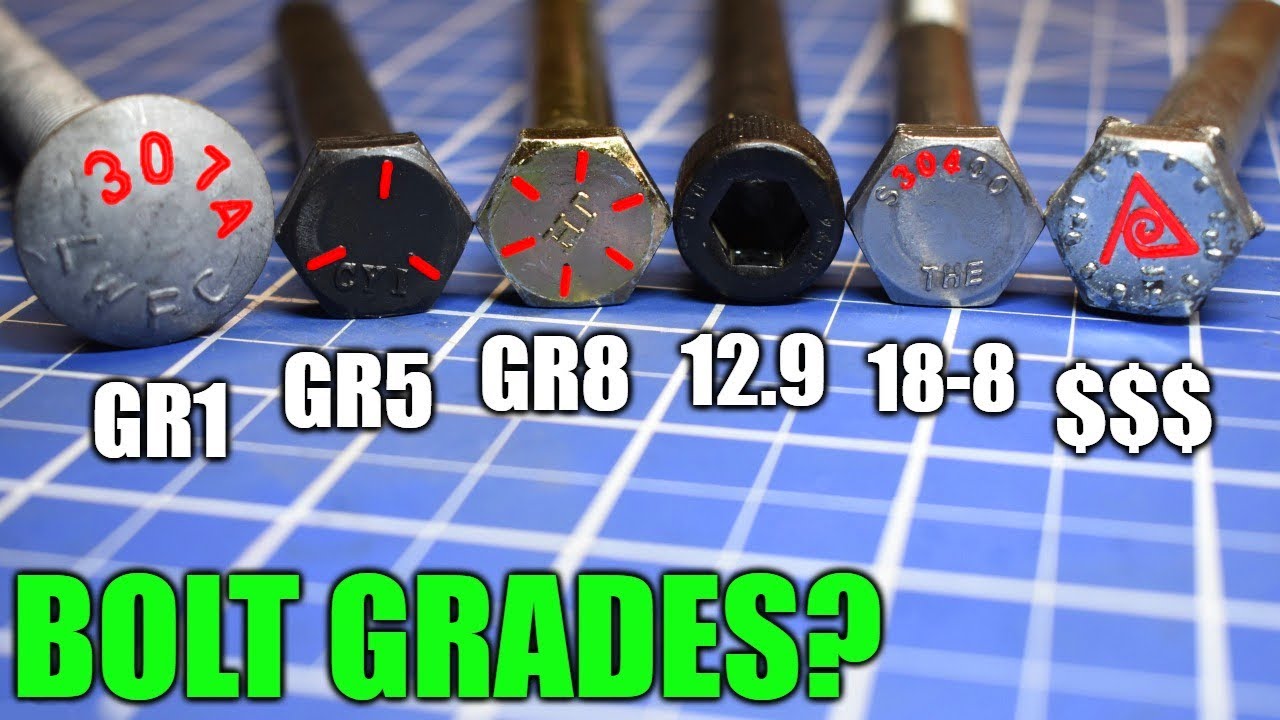
This independent workshop test compares common bolt grades under controlled destructive loading and explains why markings and standards matter. It is educational context, not a source for design allowables or purchasing substitutions.
Put the standard, exact grade or property class, edition, dimensional standard, thread system and tolerance, diameter and length, thread length, material or type, finish, lubrication, compatible nut and washer, marking, lot traceability, inspection documents, test certificates, packaging, and quantity on the RFQ. State application-specific approvals and whether substitutions are prohibited.
On receipt, check purchase order and certificate consistency, head markings, dimensions, thread gauges, finish, lot identification, and packaging. Use a qualified laboratory for proof-load, wedge-tensile, hardness, chemistry, decarburization, coating, or embrittlement-related tests as required. TNHO’s fastener measurement guide helps organize dimensional checks, but it cannot replace mechanical verification.
When a supplier proposes an alternative, require a written cross-reference covering every governing requirement rather than one headline strength number. Engineering should review dimensional fit, nut and washer compatibility, preload method, environmental performance, marking, documentation, and end-use approvals. Keep the approval with the drawing revision and purchase record so a future buyer does not mistake a one-time engineered deviation for a general equivalence.
Retain an approved sample and photograph with the inspection record when identification is difficult. That reference supports future receiving checks, but the current certificate and lot traceability remain the controlling evidence.
No. They belong to different standards systems and have different designations, requirements, dimensions, markings, and application contexts. Do not substitute one for the other without a complete engineering review.
No. Color usually reflects material appearance or coating and is not reliable grade evidence. Use required head markings, traceability records, certificates, and testing appropriate to the application risk.
No. Higher strength can reduce ductility, increase coating and embrittlement concerns, change tightening needs, and shift failure into the nut or joint. Select the grade that fits the calculated load, environment, installation method, and governing standard.
Include the standards system and edition, exact grade or class, dimensional standard, thread, size, length, material/type, finish, lubrication, compatible nut and washer, marking, certificates, application approvals, and substitution rules.

 TNHO
TNHO 


