Patched screw storage segregation should preserve three things together: the screw specification, the identity of the applied patch, and the release status of the lot. Keep unopened receipts, approved production stock, line returns and suspect parts in distinguishable containers. Transfer the lot identity whenever screws move into a smaller picking tray. A blue area on a thread is a visible feature, not enough information to assign a coating formulation, storage lifetime or reuse allowance.
This guide addresses the handoff between receiving, stores and assembly. It does not set a universal humidity limit or replace a coating supplier’s instructions. The objective is to prevent a correctly purchased fastener from becoming an unidentified or contaminated item before installation.
The TNHO Torx screw product family includes screws with optional blue nylon patches. The illustrated reference has a short threaded shank, silver pan head and a blue patch on part of the external thread. The product page lists M3×10 among its standard sizes. A photograph cannot establish the exact patch chemistry, coating approval or condition of a delivered lot. Those details belong in the purchase specification and accompanying records.
Start a storage record with the drawing revision, thread and length designation, head and drive requirements, surface finish, patch specification and supplier lot identifier. Distinguish the screw manufacturer’s lot from a separate patch applicator’s reference when both are supplied. Keeping that relationship makes a later question about a coating process easier to investigate without treating every similar-looking screw as affected.
For the broader function of this product family, see nylon-patched Torx screws in meter assemblies. Storage control preserves an approved configuration; it does not establish the joint’s resistance to loosening.
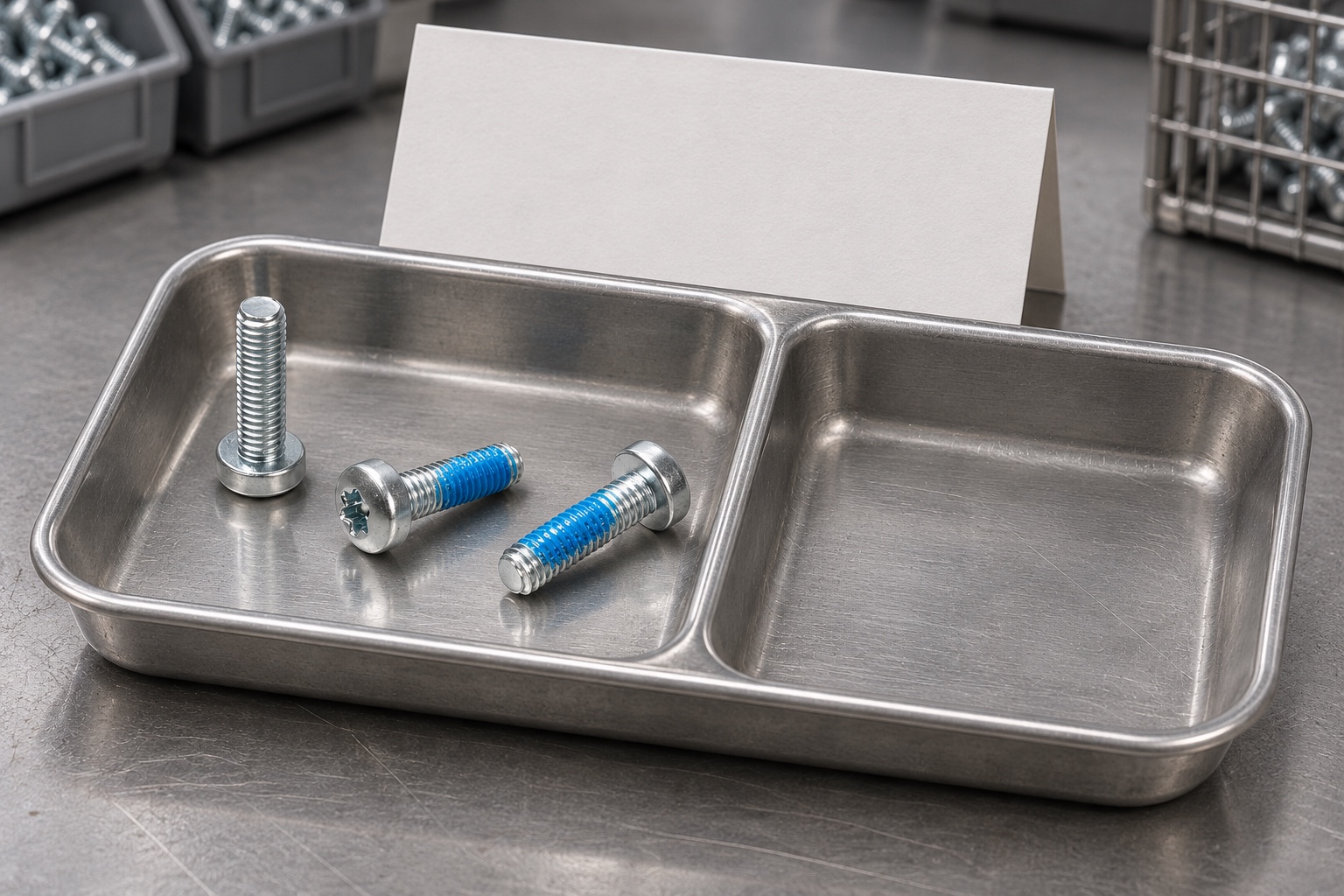
Three different boundaries can exist within one shelf. Configuration separates different screw and patch specifications. Lot identity separates deliveries that share a specification but have different production histories. Disposition separates usable stock from stock awaiting inspection or investigation. One container label should communicate all three without relying on its physical location alone.
Do not merge two partial cartons merely because the threads appear identical. If an approved procedure permits consolidation, it must preserve the constituent lot identities and explain how an assembly issue would be traced back. A mixed container with one surviving label creates a stronger appearance of traceability than the records actually support.
Use a distinct holding location for damaged packaging, uncertain labels and reported exposure incidents. A hold is an administrative boundary, not evidence that the screws have failed. It gives the responsible person a chance to decide what inspection, supplier advice or disposition is needed before an operator unknowingly uses the parts.
Bulk packaging is often split into smaller quantities at a supermarket shelf or assembly cell. The transfer can remove the very label that explained what was inside. Prepare the receiving tray identification before pouring, then reconcile the source container and destination. Include a practical method for recording the quantity transferred and the person or station responsible.
Use containers whose previous contents and cleanliness are known. An empty-looking tray may still contain a similar screw under a divider or residue from another process. Inspect the tray before filling it. When a divider can shift during transport, consider whether compartments are sufficiently secure for these small parts rather than assuming that visual separation will survive handling.
Maintain identification on lids as well as containers only if the matching procedure prevents lids being swapped. A lid carrying the sole lot label becomes a problem when several trays are open together. A label on the container body, with a separately managed lid, usually makes the identity easier to retain through normal picking.
The following table is a suggested workflow to adapt to the factory’s quality system. It does not prescribe a coating acceptance limit.
| Stock event | Keep separate from | Information to retain | Release question |
|---|---|---|---|
| New receipt awaiting checks | Approved line stock | Purchase order, drawing revision, supplier lot | Have receiving requirements been satisfied? |
| Approved carton split into trays | Other configurations and unrecorded lots | Source lot, destination and transfer quantity | Can each tray still be traced? |
| Unused parts returned from a cell | Unopened stock | Original issue record and known exposure | Did handling preserve the specified condition? |
| Damaged or unlabelled container | All released stock | Discovery location and incident details | Is identity and condition recoverable? |
| Suspected oil or cleaner exposure | Unaffected parts | Chemical identity, time and affected route | Who may authorize evaluation or disposal? |
The table is most useful when each row names an owner. If nobody is responsible for line returns, the default often becomes pouring them into the nearest carton. A short, explicit return path prevents that convenient action from silently becoming the storage policy.
Keep the screws in the supplier’s suitable packaging until there is a controlled reason to transfer them. Protect open trays from debris, accidental liquids and contact with unrelated finishing or cleaning operations. Choose any liner or additional packaging with the supplier’s compatibility advice; an unfamiliar foam, adhesive or oily paper can introduce a new exposure instead of solving one.
The Canadian Conservation Institute’s guidance on plastics and rubbers describes how polymers can respond differently to contaminants, cleaning agents and their surroundings. Its context is conservation, not industrial screw qualification. The relevant lesson here is limited: polymer materials should not all be treated as chemically interchangeable. It supplies no storage limit for the illustrated TNHO patch.
Obtain the applicable storage period, temperature range, packaging restrictions and inspection requirements from the identified patch supplier or approved specification. Record the document revision and the date basis for any limit. Do not copy the shelf life of a chemically reactive adhesive onto a nylon patch, or use a competitor’s color chart to interpret a blue coating.
Stock rotation must use the correct date. Receipt date, manufacture date, patch application date and expiry date are different fields. If a purchase requirement defines a validity period from coating application, a warehouse receipt stamp cannot replace that starting point. Ask for missing information before assigning a seemingly precise expiry label.
When replenishing a picking location, remove or identify the remainder before adding the next lot. A two-container system can keep the active lot separate from its replacement, provided the station’s issue and return records follow the same rule. The number of containers is less important than being able to identify the screws actually available to the operator.
The NASA fastener procurement, receiving and storage publication is a mission-hardware reference, not a claim that these commercial screws meet NASA requirements. It is useful background for treating procurement, receiving and storage as linked controls rather than isolated warehouse tasks. Apply the customer’s own contractual requirements to the actual delivery.
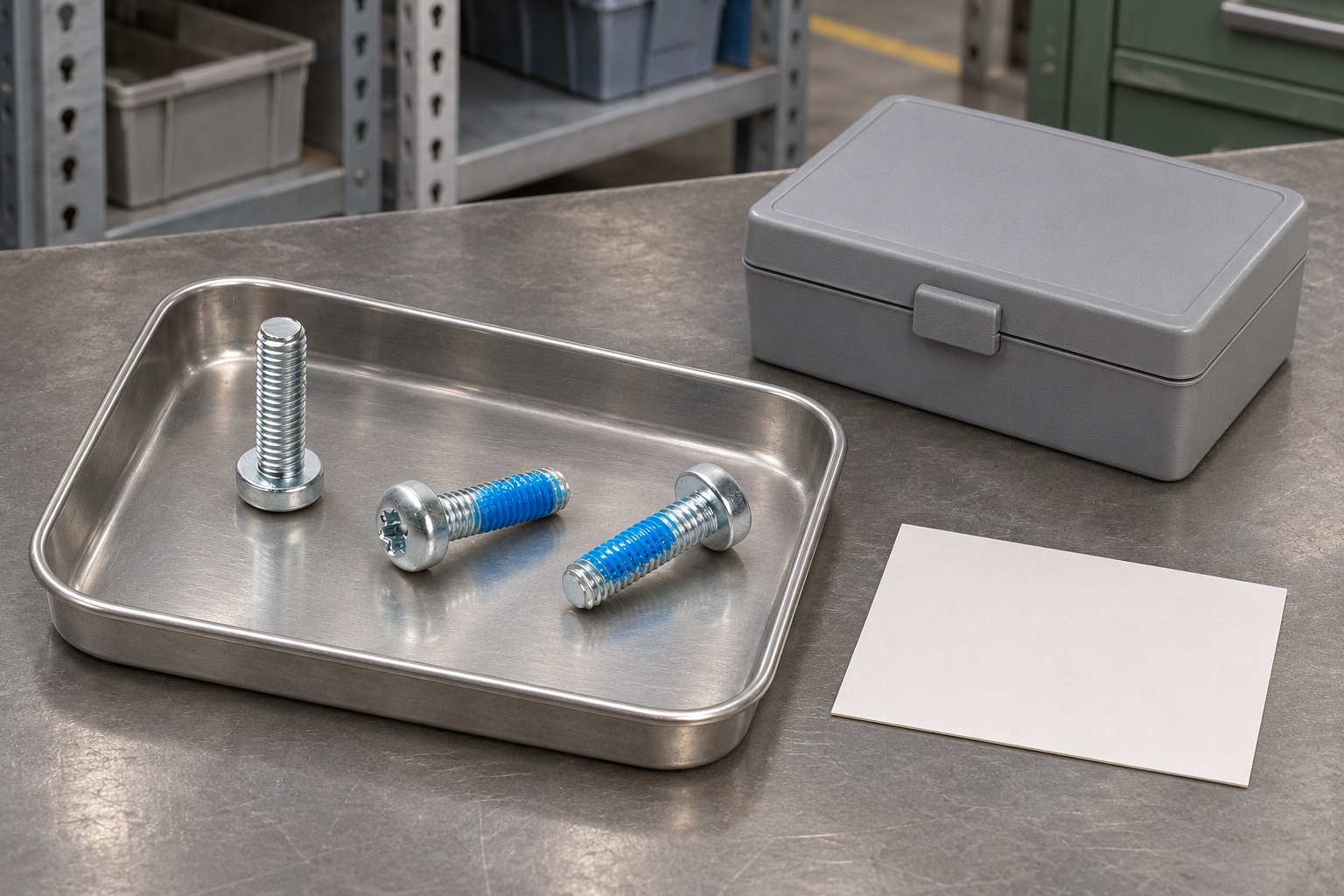
An unused screw is not necessarily an unopened screw. Parts may have been tipped into a feeder, handled with contaminated gloves, mixed with a previous lot or carried through a cleaning area. Record what is known about the route instead of deciding solely from whether the screw was installed.
Keep removed or trial-installed screws separate from unused line returns. Storage staff should not decide that the patch can be reused by turning a screw into a loose nut and judging the resistance by hand. That introduces another uncontrolled assembly and provides no qualified acceptance result. The responsible engineering or quality instruction must define any permitted reuse evaluation.
Questions about wiping, degreasing or exposure belong in the nylon patch screw cleaning boundary review. A storage incident should trigger that specific review rather than an improvised solvent treatment at the shelf. Keep the affected container and its incident record together until a disposition is recorded.
A practical issue record connects the stock location, screw configuration, lot and receiving assembly order. It should allow someone to investigate a complaint without opening every carton or relying on an operator’s memory. Where exact piece counting is impractical, document the approved quantity-control method and its limitations rather than recording an unsupported exact total.
Review the route after a pilot issue and return. Check whether the label survives transfer, whether an operator can distinguish a hold container, and whether leftover parts have a defined destination. These observations test the handling process; they do not demonstrate the patch’s mechanical performance. General moisture and corrosion considerations are covered separately in the fastener storage guide.
For a supply request, send the screw drawing, patch specification, intended packaging quantities, lot-identification fields and return policy. Ask the supplier to identify which storage conditions are supported for that exact configuration. This creates a clear boundary between purchasing an approved product and preserving its condition before use.
NPTEL IIT Guwahati’s “Lec 27: Material handling systems” provides an educational introduction to the movement of material through a production system. Use it to think about transfer points and handling routes. It does not establish a patch formulation, shelf life or acceptance procedure for this screw.

Only when the approved procedure preserves the required identities and permits that arrangement. Similar appearance is insufficient. If the resulting mixture cannot be traced to its constituent lots, keep the lots separate.
No. Color alone does not identify the complete formulation or its storage requirements. Obtain the applicable instructions for the supplied patch and record the date basis used for any time limit.
They should follow the defined return review first. Confirm their identity, handling history and condition, and keep trial-installed or removed screws separate. Unused does not automatically mean equivalent to unopened stock.
Do not add oil or another treatment without approval for the complete screw and patch configuration. A corrosion precaution can change the condition of the patch or the assembly interface. Request supplier guidance and document the approved disposition.




 TNHO