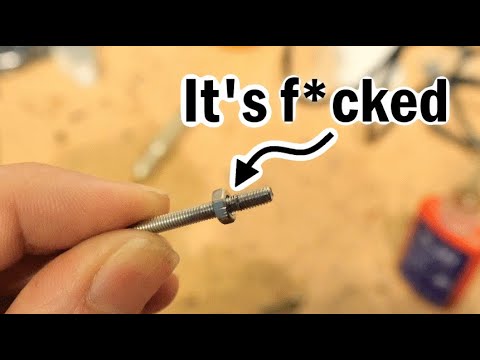
Stainless steel fastener galling is a form of adhesive wear in which highly loaded sliding thread or bearing surfaces locally seize and transfer material. It is most likely when compatible stainless surfaces slide together under high contact pressure without a suitable, validated lubrication or surface system. The fastener can become difficult to turn, generate debris, damage the internal thread, or lock before the joint reaches its intended clamp load. Stainless steel resists corrosion, but that does not make stainless-on-stainless threads immune to galling.
Thread flanks and bearing faces touch over small areas. During tightening, those areas carry pressure while the parts slide. If surface films break down, microscopic high points can adhere, shear, and transfer material between the mating surfaces. The transferred material raises friction and may create rough patches that catch subsequent threads. A fastener may slow abruptly, squeal, seize, or fail during removal. Severe damage can strip or shear the screw even when the nominal torque seems ordinary.
The NASA fastener report on removal problems in flight hardware documents galling that began during installation when a specified dry-film lubricant was absent. The NASA Fastener Design Manual also discusses stainless fasteners, materials, lubrication, coatings, and torque. These examples support controlling the complete assembly condition, not assuming a material label guarantees anti-galling performance.

Risk increases when similar stainless alloys run together without a qualified lubricant, when contact pressure is high, or when assembly speed creates heat. Poor alignment, cross-thread starts, contamination, damaged threads, rough surfaces, and repeated reuse can add local stress and abrasive debris. A nut or screw that reaches a prevailing feature may require extra rundown torque; that resistance should not be confused with clamp-producing torque.
Fasteners with small diameters can still gall because the contact area is small and the local pressure can be high. A low nominal installation torque does not by itself prove the interface is safe. Conversely, a rising torque trace is not automatically galling. A stiff joint, a bottomed screw, thread interference, coating buildup, or an incorrect part can create a similar symptom.
| Condition | Why it raises risk | Early clue | Control to evaluate |
|---|---|---|---|
| Similar stainless mating surfaces | Adhesive transfer can occur when films fail during sliding | Torque rises sharply or thread surfaces show smeared metal | Qualified material pairing, coating, or lubricant |
| Dry or inconsistent lubrication | Changes friction and leaves no controlled anti-galling film | Large torque scatter between parts or production lots | Specify lubricant, location, quantity, cleanliness, and process |
| High installation speed | Increases frictional heating at contacting thread flanks | Seizure during powered rundown or removal | Control rundown speed and validate the production tool |
| Misalignment or cross-thread start | Concentrates load on a few thread contacts | Resistance before the joint seats, metal debris, damaged lead threads | Improve coaxial location and hand-start method |
| Reuse or contaminated hardware | Transferred metal, debris, and coating wear change the next cycle | New scratches, rough run-down, inconsistent removal | Define single-use or tested reuse criteria and clean handling |
| Uncontrolled coating or plating | Surface thickness and friction can vary or become damaged | Fit change, flaking, or torque shift after a supplier change | Control the complete coating system and inspect finished parts |
The table is a troubleshooting guide, not a galling-life rating. Test the specified screw, mating thread, finish, and lubricant together before release.
Cross-threading begins with incorrect alignment or pitch engagement. The first few turns may feel wrong, and damage often appears at the thread entrance. Bottoming occurs when the fastener reaches the end of a blind hole before the parts seat. Thread stripping removes or shears the internal or external thread because its capacity is exceeded. Galling is adhesive wear during sliding contact and can develop after an initially correct start.
Stop assembly when resistance changes unexpectedly. Do not force the joint with a powered tool or increase torque to push through a suspected seizure. After removing the part where possible, inspect the first engaged threads and bearing surfaces, compare with an unused control, and identify whether the issue is alignment, interference, bottoming, stripping, or material transfer.
Start with the mating materials and service environment. Specify the screw and internal thread material or coating, the lubricant system, temperature range, contamination restrictions, and whether electrical contact, cleanliness, or corrosion resistance is critical. A lubricant that controls assembly friction may be prohibited in a clean assembly or may affect a gasket, coating, or electrical interface. Validate compatibility before production.
Use the correct engagement, thread class, hole preparation, and alignment. Avoid forcing a screw into a poor lead-in. Consider dissimilar material pairings or a qualified surface treatment when allowed by the design. Do not assume that two different stainless grades automatically prevent galling; confirm the exact pair under the intended load and assembly cycle.
Anti-seize compounds and lubricants are not interchangeable with thread-locking adhesives. An anti-seize product is intended to reduce metal-to-metal friction and ease disassembly, while a locking adhesive changes resistance and may cure in the thread. Either can affect torque-tension behavior, cleanliness, sealing, and electrical contact. Specify the product, application surface, amount, cure or drying condition, and any service temperature or chemical limits. Do not apply a shop compound to a validated assembly without engineering approval.
Threaded inserts or a dissimilar nut material may provide a controlled mating surface in some designs. The insert still needs adequate retention, strength, temperature capability, and installation quality. A softer mating surface can reduce adhesive transfer in some configurations but may instead strip or deform. Treat substitutions as a joint redesign and test the complete assembly.
Document tool speed, torque strategy, seating detection, tightening sequence, and single-use policy. If repeated service is required, test the full number of cycles and inspect both male and female threads after each interval. A successful first installation is not evidence that repeated assembly will remain safe.
Test production-intent screws, tapped parts or nuts, coatings, lubricants, tools, and assembly speeds. Record rundown torque, final torque, angle, clamp force when relevant, temperature, seizure events, removal behavior, and visual damage. Include parts from representative manufacturing lots because surface finish and lubricant application can vary.
ISO 16047 specifies conditions for torque/clamp-force testing of covered threaded fasteners. It can support controlled comparison of installation behavior where the product falls within its scope, but it is not a universal galling-life test. Add application-specific repeated-assembly, temperature, vibration, or contamination tests when the service risk requires them.
This focused demonstration introduces stainless fastener galling and prevention ideas. Use it as background only; the selected materials and process still require project-specific validation.

Preserve failed hardware and an unused control from the same lot. Photograph the screw, mating thread, and bearing faces before cleaning. Record the assembly tool, setting, lubricant, operator or machine, environmental condition, lot numbers, and the point at which resistance changed. Examine whether transferred metal is present and whether the damage began at the lead thread or farther into the engagement.
Replace damaged fasteners and mating parts unless an approved engineering disposition permits repair. Chasing a thread can remove material, change fit, hide the original cause, and leave a joint with unknown strength. Corrective action should address material pairing, surface condition, alignment, lubrication, tool speed, or a wrong part, then repeat the qualified test.
TNHO’s combination screw product family illustrates a stainless pan-head machine screw style. The actual grade, dimensions, coating, and drive are controlled by the approved drawing and quotation. For the material pairing, see the 304 versus 316 stainless screw guide. The fastener friction coefficient guide describes the torque and surface variables, and the prevailing-torque nut guide distinguishes locking resistance from clamp-producing torque.
An RFQ should identify both mating parts, material and finish, lubricant, assembly cycles, cleaning requirements, target clamp behavior, testing protocol, and acceptance criteria. A request that says only “stainless screw” leaves out too much information to predict galling performance reliably.
Galling occurs when highly loaded sliding metal surfaces adhere, shear, and transfer material. Similar stainless mating surfaces, poor lubrication control, high contact pressure, heat, contamination, and misalignment can increase the risk.
Yes. Nominal torque is not a direct measure of local thread contact pressure or surface condition. Small fasteners can seize if the material pairing and lubrication are unsuitable, so test the actual assembly.
No. A compatible lubricant can reduce sliding resistance, but its effectiveness depends on the material, application location, amount, temperature, cleanliness, and service environment. Validate the specified process.
Do not reuse damaged hardware unless the responsible engineer approves a documented disposition. Cleaning may remove loose debris but cannot restore sheared or transferred material, thread form, or the original friction condition.

 TNHO
TNHO