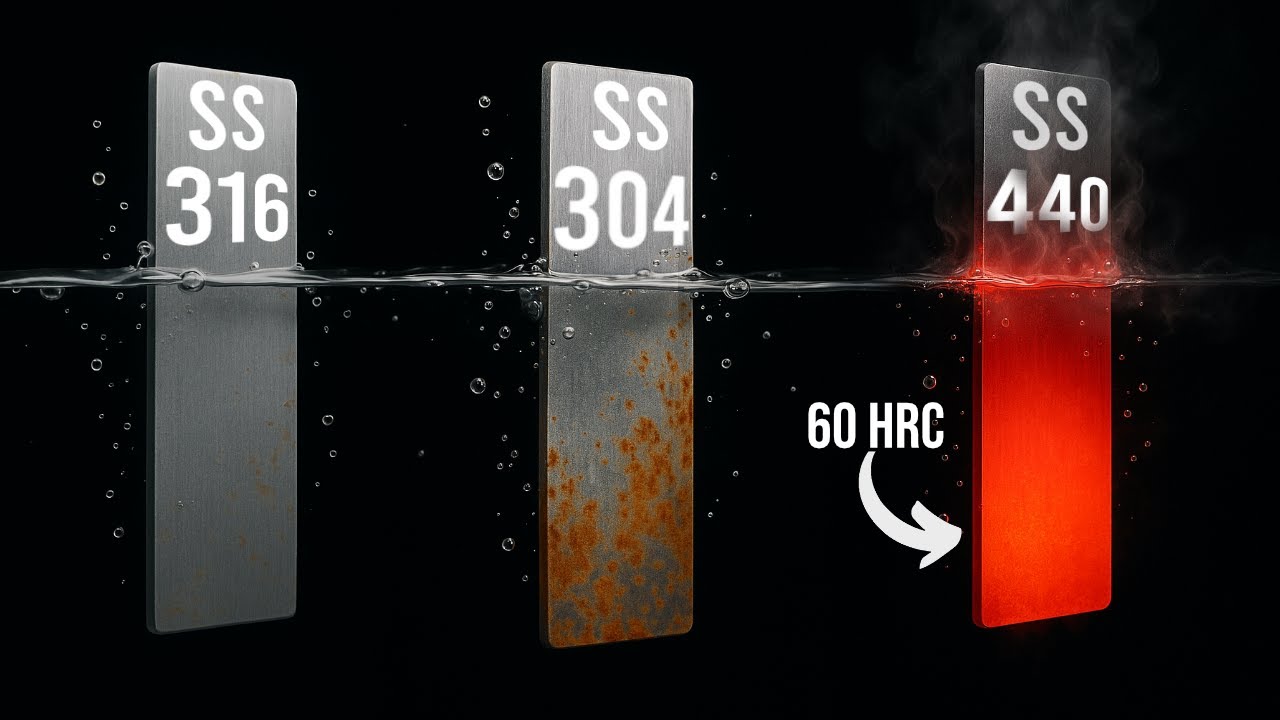
304 vs 316 stainless steel screws is an environment-first decision. Both are common austenitic stainless families, but 316 contains molybdenum that improves resistance to localized chloride attack. A 304 screw may suit a dry cabinet or a moderately wet location after the joint is reviewed; 316 is a stronger starting candidate where salt spray, road de-icing deposits or chloride-bearing washdown raises pitting and crevice risk. Neither alloy is corrosion-proof, and neither designation tells you the screw’s complete strength, thread tolerance or installation behavior. Specify the actual screw grade, product standard, geometry and required evidence for the finished fastener.
Bright screws can be 304, 316, plated carbon steel or another alloy. A camera image, magnet check or visual color comparison is not a reliable substitute for a traceable material record. The British Stainless Steel Association explains that the molybdenum addition in 316 helps the passive surface resist local breakdown by chloride ions compared with 304; see its corrosion-resistance introduction. That relative advantage matters most when the exposure actually includes chlorides, especially in a damp crevice.
On a finished screw, alloy chemistry is one input among several. Cold work, product geometry, thread form and property class affect mechanical performance. A 316 material callout does not automatically give a higher clamp load than 304. If the design specifies ISO fastener grades such as A2 and A4, use the relevant ISO 3506-1 designation and property class instead of casually replacing it with a raw-material shorthand. Our separate A2 versus A4 fastener guide explains that procurement language in more detail.

Ask where the screw is installed, not just whether the equipment is described as “outdoor.” A meter enclosure on a sheltered wall can have a very different exposure from one alongside a winter road or a coastal industrial site. Windborne salt may collect behind a head or washer and remain wet long after the cabinet face dries. Cleaning agents, temperature, cyclic wetting and deposits can raise the risk. If a screw enters a plastic housing, water trapped in a counterbore can still reach its head and threads.
316 is often preferred over 304 in higher-chloride conditions, but it can still pit or suffer crevice corrosion. The BSSA’s seawater discussion notes the significance of site and surface condition. Do not read “marine grade” as approval for indefinite seawater immersion or an unventilated saline crevice. For a high-consequence assembly, qualify the entire joint in representative service conditions or seek a corrosion specialist’s decision.
| Exposure or design case | 304 screw assessment | 316 screw assessment | Question before ordering |
|---|---|---|---|
| Controlled indoor enclosure | Often a practical candidate | Usually assess only if another requirement calls for it | Is moisture or chemical cleaning actually present? |
| Rain-wetted exterior cabinet | Review drainage and retained water | Consider if crevices remain damp | What occurs behind the head or gasket? |
| Salt deposition or road spray | Higher localized corrosion concern | More defensible initial choice, still requiring review | How concentrated and persistent is chloride exposure? |
| Continuous seawater or concentrated chemical | Not a default solution | Not automatically sufficient | Is a more resistant material or joint redesign required? |
The table deliberately avoids invented corrosion rates or service-life promises. BSSA’s fastener guidance links material grade to recognized product-class requirements. If a project has a governing industry or customer specification, follow it instead of using this table as a formal acceptance criterion.
A stainless screw can contact an aluminum bracket, a plated steel nut, a brass terminal or an insert. Dissimilar metal contact in a conductive wet environment can change corrosion behavior; the exposed-area ratio and drainage influence where damage concentrates. Electrical equipment brings another distinction: a structural cover screw and a current-carrying terminal fastener have different performance requirements. Never select a screw solely from bulk electrical conductivity when the contact interface, plating and tightening procedure control the actual connection.
Inspect under-head surfaces, washer seats and blind threads for moisture traps. Where a joint will be opened repeatedly, assess galling: stainless mating threads can seize, especially with high contact pressure and poor lubrication. Use only a lubricant or anti-seize compound that is compatible with the electrical, temperature and cleanliness requirements, and validate any changed torque/preload relationship. A material upgrade that causes unanticipated assembly damage is not a successful substitution.

For a custom quotation, send a controlled drawing with nominal size and pitch, tolerance class, head and drive, length, thread length, material designation or ISO fastener grade/property class, surface finish, passivation if required, and any locking feature. State whether the corrosion requirement applies to the component or the assembled joint. A statement such as “316 stainless, equivalent acceptable” is ambiguous unless the equivalence criteria and test evidence are defined.
TNHO’s Torx screw product family lists 304 stainless and coated carbon-steel options. The pictured part is a useful reference for shape and anti-loosening features, not evidence that a 316 version is already qualified or on the shelf. Ask the manufacturer to confirm a 316 design, process capability and traceable material supply for the requested dimensions. For access and driver choice, see Torx versus hex socket screws; for joint length, see thread engagement guidance.
Keep the purchase order, supplier certificate and actual lot linked. Depending on risk, an agreed positive material identification method can help distinguish alloy families, but verify the method’s ability to resolve the required chemistry and its limitations on small parts or plated surfaces. Material identification does not verify strength class, thread fit, passivation or locking torque. Check those independently to the controlled drawing and inspection plan. A passed thread gauge is not a corrosion qualification.
Sample screws in final delivered condition, including any patch or coating. Look for transit contamination and packaging that mixes grades or permits contact with carbon-steel debris. If a returned field screw shows red staining, identify whether it comes from the screw itself, an adjacent plated part or transferred contamination before concluding that the stated alloy is false. Preserve failure samples with the mating components and site-exposure notes; cleaning everything first can destroy useful evidence.
304 is not a low-quality material. If environmental testing and service conditions indicate modest corrosion risk, it may meet the design at lower cost and with more familiar supply. The comparison should include verified product availability, manufacturing method and performance of the assembled joint. Buying 316 for every indoor screw can increase cost without addressing more important failure modes such as a poor seal, a misaligned thread or insufficient engagement.
Consider a sheltered meter cabinet that is opened during maintenance. The screw head may be exposed to occasional condensation, while its internal threads remain dry. The design team can inspect the drainage path, compare field history, and qualify a 304 option with the specified mating hardware. Move the same cabinet next to a road treated with de-icing salt and the exposure changes: spray can accumulate at the gasket and under the screw head. That is a reason to reassess the material and joint design, not to reuse the indoor material decision without evidence. Neither example establishes a guaranteed lifetime or a universal boundary between the two alloys.
Likewise, a failure in a severe chloride environment should not be “fixed” merely by changing 304 to 316 on the next purchase order. Review whether the joint needs drainage, a different gasket, isolation from a dissimilar material, better cleaning or a more corrosion-resistant alloy. Reassess service life and maintenance access. The correct answer is a validated assembly specification, not a label on a bag.

The independent engineering education video below explains common stainless families and includes a specific section on 304 and 316. It provides material background; use project standards and testing for the actual screw and exposure.
No. Mechanical properties depend on the finished fastener’s grade, class, geometry and processing. Select strength separately from corrosion resistance.
No. 316 improves resistance to many chloride exposures but can still suffer pitting or crevice corrosion in sufficiently aggressive conditions.
Ask the supplier for a specific quotation and evidence. An image or a general product listing does not prove that an alternate alloy is qualified or stocked.
No. Traceable material documentation and a suitable verification method are needed when grade distinction matters.

 TNHO
TNHO