FTIR analysis of fastener residue can help investigate organic films by comparing infrared absorption patterns with suitable reference materials. It is useful when a screw carries an unexplained oily or polymer-like deposit, but it does not automatically identify every ingredient, establish total surface cleanliness or prove which manufacturing step caused the residue. Start with a traceable as-received sample, a clear sampling location and appropriate blanks. Select the sampling approach with the laboratory, then interpret the spectrum together with process history and complementary evidence. A missing or weak signal means no convincing identification under those conditions, not proof that the part contains no contamination.
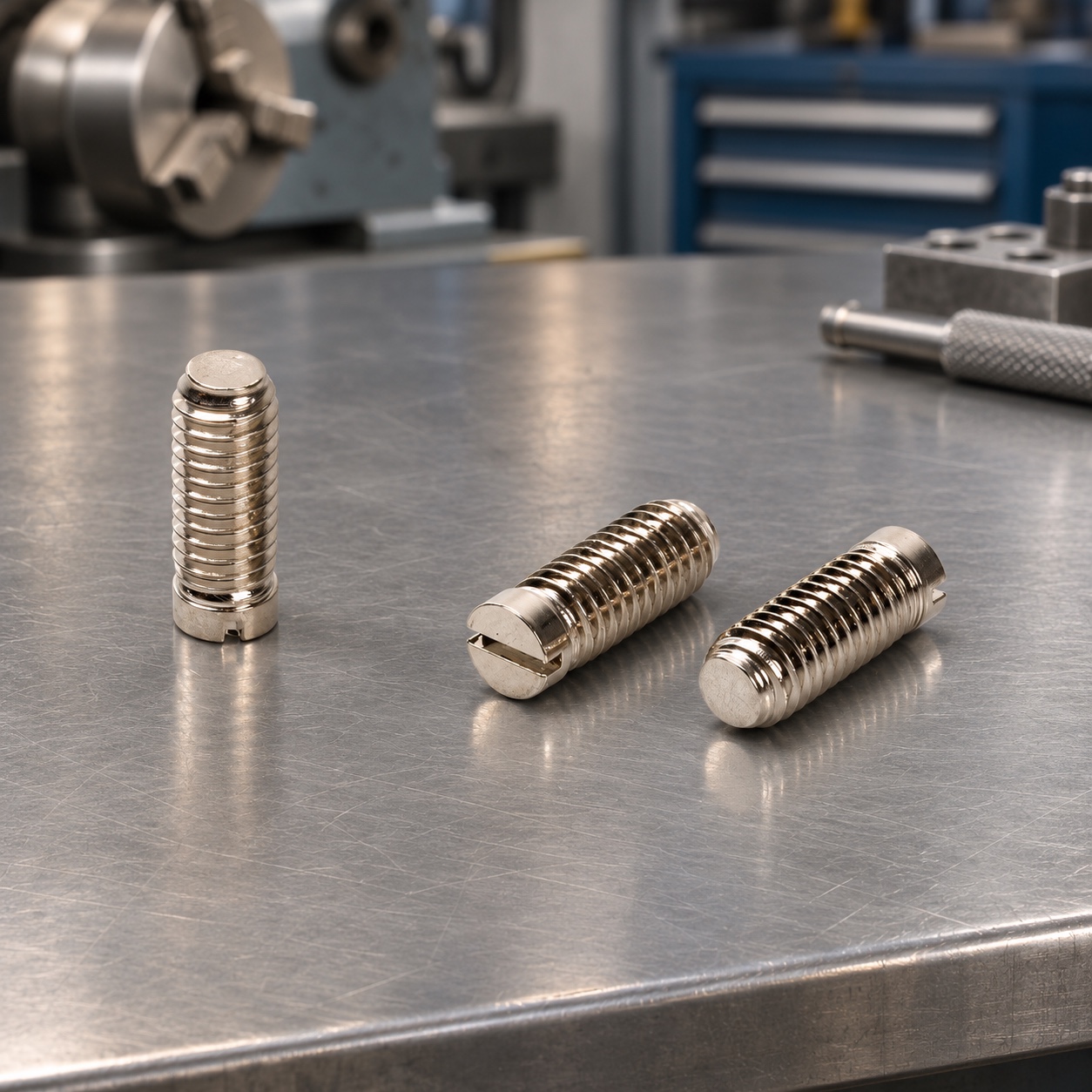
A hex socket screw offers several distinct sampling locations: the head, socket recess, threads and bearing face. A residue in one location may not represent the whole part. The product shown here is an exterior reference for discussing sample handling; its appearance does not establish a lubricant, coating, material grade or measured cleanliness level.
An investigation should begin with the decision the result must support. Are you comparing an unexpected film with a known process oil? Checking whether a cleaning change leaves a different residue? Investigating a deposit on returned components? Each question requires different controls. A general request to identify everything on the screw can produce a technically competent spectrum that still fails to answer the purchasing question.
The NIST FTIR instrument overview explains that infrared measurements provide information about molecular structure and functional groups, with several sampling modes available. That is a different type of evidence from an elemental composition measurement. FTIR should be selected because the suspected residue and sampling conditions suit the question, rather than because it is a familiar laboratory acronym.
Identify whether the surface is expected to carry an intentional lubricant or protective film. Removing all detectable organic material might be inappropriate for the specified product. Ask which condition is required at delivery and which substances are allowed, restricted or under investigation. A sample can be different from an approved reference without automatically violating the contract; the requirement must be defined.
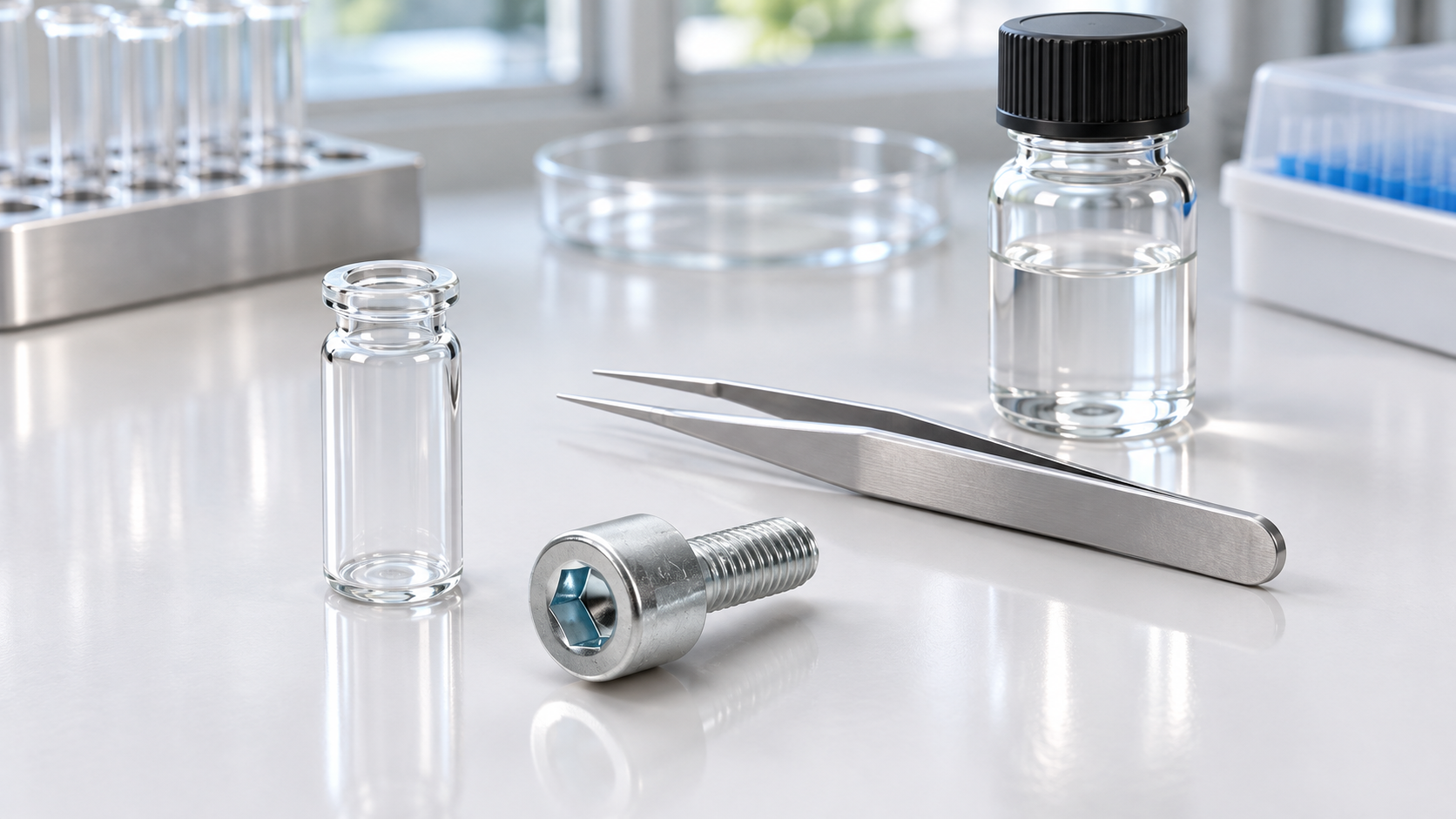
Direct examination may be possible when the residue is accessible and the geometry suits the instrument accessory. ATR, or attenuated total reflectance, depends on suitable contact between the sampled material and the crystal. Pressing an awkward screw against a delicate accessory is not an acceptable improvisation. Let the laboratory assess contact, potential damage and whether residue transfer offers a more suitable route.
A transferred residue, swab extract or solvent extract can make a small deposit easier to examine. Each introduces its own limitations. The swab, container, solvent and transfer surface can contribute a signal, while the collection process may recover some materials more effectively than others. Record what was sampled and how. An extract represents the recovered material under that method, not necessarily every substance originally on the part.
The laboratory should explain which accessory and sampling route can address the suspected residue, including whether a local film can be examined directly. For purchasing decisions, the important step is translating that analytical capability into a documented sampling plan for the actual component. Do not apply a generic detection limit or penetration depth to an unknown residue on a threaded screw without method-specific validation.
Retain unopened or minimally handled samples where possible. Record packaging condition, time of receipt and the tools used to remove the fasteners. If the investigation concerns packaging transfer, keep a separate packaging sample and identify the specific contact surface. Store comparison materials separately so a reference oil or adhesive cannot contaminate the questioned part before analysis.
A useful blank follows the relevant collection steps without intentionally contacting the questioned residue. For example, an extraction blank may involve the same solvent and container. Its exact design depends on the laboratory method. A spectrum from a clean crystal alone does not evaluate contamination introduced by every later sampling operation. Ask the laboratory to explain which part of the process each control covers.
The East Carolina University study of methodological contamination in FTIR residue analysis concerns a different application field, but it demonstrates why sampling materials and controls deserve explicit attention. It should not be used as a fastener acceptance standard. Its practical relevance here is the need to investigate material introduced by collection and preparation before attributing a signal to the original part.
| Investigation question | Samples or controls to discuss | Useful reporting boundary |
|---|---|---|
| Is the film consistent with a known process oil? | Questioned residue and a traceable sample of that oil | Similarity supports a comparison; it does not prove the source step |
| Did the cleaning change alter recovered residue? | Comparable before-and-after samples with consistent collection | A difference is method-dependent and must be separated from sampling variation |
| Could packaging contribute material? | Packaging contact surface and collection blanks | A shared spectral feature alone does not establish transfer direction |
| Is a local deposit different from the surrounding surface? | Documented deposit and adjacent comparison location | Report the locations separately instead of calling the whole screw contaminated |
| Can the result support a cleanliness requirement? | Validated method, recovery information and agreed criterion | Identification alone does not establish mass per area or total cleanliness |
This table is an investigation checklist, not a list of guaranteed instrument capabilities. Ask the laboratory to confirm feasibility before committing a limited sample set. Where the required measurement is a residue quantity, the method needs a suitable quantitative basis. Do not relabel a qualitative library match as a concentration measurement.
A library search can generate candidate materials, but its top result is not automatically a unique identification. Mixtures, degraded films and thin deposits may share prominent features with multiple references. The report should distinguish a consistent material family from a specific compound identification and explain important unmatched features. Keep the original spectrum and relevant collection settings available for review.
Reference materials should have a documented identity and relationship to the process. Comparing with an old bottle from an unknown source can create false confidence. If a lubricant changed formulation, the reference should reflect the material relevant to the lot being investigated. Where several process materials may contribute, examine them separately before making a causal claim about a mixed deposit.
Avoid interpreting peak height differences as residue quantity unless the comparison is supported by a validated approach. Different contact, sample thickness or recovery can change intensity. Similarly, a visually obvious film may still be difficult to characterize under an unsuitable sampling method. Describe the analytical limitation directly and consider another method when the required decision remains unresolved.
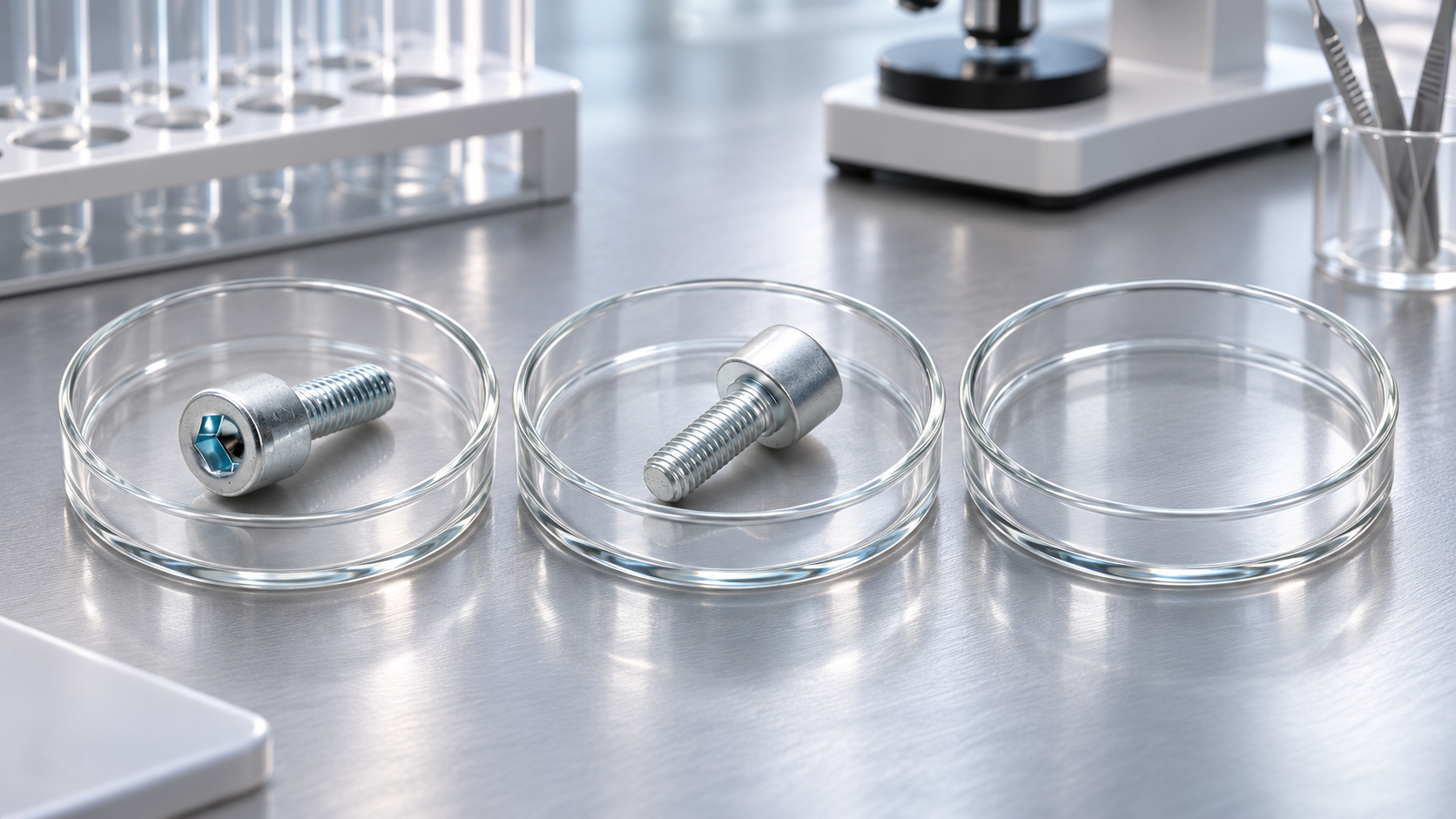
A fastener cleanliness requirement can include particulate and film-related concerns that require different measurements. FTIR evidence about recovered organic material does not replace a particle count, a gravimetric residue measurement or a customer-specific cleanliness procedure. Specify the attribute that matters rather than asking a single technique to certify an undefined state of being clean.
Localized SEM-EDS analysis offers different evidence about local morphology and elemental content. It can be useful for some deposits, but its result should not be treated as a complete molecular identification of an organic film. Choose complementary methods because they close a specific evidence gap, and preserve sufficient specimens for each operation.
A simple location map can be more valuable than an extra unspecific test. Record whether the deposit is in a socket, concentrated on a thread or present on packaging-facing surfaces. Photograph it before sampling and identify the inspected batch. This allows a later process review to connect the analytical findings to handling and manufacturing records without relying on memory.
Suppose incoming screws show a patchy transparent film after a packaging change. Preserve a group in its delivered state, retain the new packaging and obtain any relevant approved process-fluid references. Ask the laboratory to propose consistent sampling and blanks, then compare the recovered residue with plausible materials. This is an investigation design, not a claim that any TNHO product has this condition.
If the residue resembles a process lubricant, verify whether that lubricant is permitted and whether the observed condition differs from the approved supply state. If packaging also shares features, investigate the contact history rather than announcing packaging as the source immediately. Traceability and controlled comparisons are what allow the chemical observation to support a corrective action.
For routine procurement, connect the investigation to OEM fastener quality control and supplier selection. Provide the drawing, lot, expected surface condition, functional concern and contractual requirement. Confirm documentation and external testing arrangements for the order. This article does not claim in-house analytical capability or certify the residue condition of the illustrated product.
The IIT Roorkee lecture below explains FTIR, infrared interactions and ATR concepts. It helps readers understand why molecular features and sampling conditions matter. It is general scientific education, not a fastener cleanliness certification or an instruction to handle solvents without laboratory controls. The written guidance above remains sufficient to scope a supplier inquiry without relying on the video.

No. It can provide molecular evidence about material detected using a defined sampling method. A weak or absent signal does not establish the absence of all contaminants. Cleanliness acceptance requires a defined attribute, validated method and agreed criterion.
Not by itself. Similar materials may share spectral features, and mixtures can complicate identification. Compare traceable process references, sampling blanks and lot history before attributing a residue to a particular operation or supplier.
Preserve representative as-received samples and ask the laboratory first. Cleaning can remove the evidence being investigated or introduce new material. If cleaned comparisons are needed, identify them separately and document the cleaning process.
Include the part and lot identity, sampling location, observed concern, packaging history, expected finish and relevant process materials. Explain the intended purchasing or engineering decision. Ask for suitable blanks and a clear statement of identification and quantitative limitations.

 TNHO