The choice between all-metal lock nuts and nylon insert lock nuts is not simply “high strength versus low cost.” Both are prevailing-torque nuts, but they generate locking resistance differently and respond differently to heat, chemicals, reuse, installation speed, galling, and vibration. A reliable choice starts with the environment and the complete bolted joint, then moves to the nut standard and test requirements.
This comparison gives designers and buyers a practical selection method. TNHO’s industrial lock hex nut range includes product-based references for the geometries discussed here, while the nuts and washers category provides the broader sourcing context.
An all-metal lock nut creates prevailing torque through controlled deformation or elastic flexing of metal threads or nut sections. Top-lock, elliptical, side-crimp, and segmented designs are common families, but their behavior is not identical. The bolt must pass through the altered locking zone, producing running resistance without a polymer element.
A nylon insert lock nut, often called a nyloc nut, uses a polymer collar retained near the top of the nut. The mating bolt cuts or forms a path through the insert. Interference between the thread and polymer creates resistance during installation and removal. The metal portion carries the structural load; the insert supplies the locking action.
Neither mechanism should be judged from color alone. An image may show a visible nylon ring or a crimped top, but it cannot verify material grade, coating, proof load, thread tolerance, insert formulation, or prevailing-torque class. Those items belong in the drawing, certificate, and inspection plan.

All-metal nuts are commonly selected when service temperature exceeds the capability of a polymer insert. However, “all-metal” does not mean unlimited temperature. Nut material, strength class, coating, lubricant, oxidation, creep of the clamped parts, and thermal expansion still set limits. Some coatings and lubricants fail well below the base metal’s temperature capability.
Nylon insert nuts work well in many moderate-temperature assemblies, but prolonged heat can soften, age, or relax the insert and reduce prevailing torque. Very low temperature can change polymer response as well. ISO 2320:2015 gives scope ranges of roughly −50 °C to +150 °C for covered all-metal nuts and −50 °C to +120 °C for covered nonmetallic-insert nuts. Use those values only for nuts conforming to that standard and confirm any narrower manufacturer or application limit.
For fire zones, exhaust systems, ovens, braking equipment, or other high-heat locations, the application standard may require special alloys, coatings, or positive locking. A generic all-metal catalog nut is not automatically suitable.
A nylon insert adds another material to the compatibility review. Fuels, oils, solvents, cleaning fluids, hydraulic liquids, moisture, ultraviolet exposure, and radiation can affect polymers differently. Obtain the insert material and compatibility evidence for the actual concentration, temperature, exposure duration, and stress state. “Nylon resistant” is too broad for a critical design decision.
All-metal nuts avoid polymer compatibility but remain subject to corrosion, hydrogen embrittlement risk for high-strength electroplated steels, coating damage, and galvanic interaction. Stainless combinations may gall. Carbon-steel nuts can corrode when the coating is damaged. The correct option depends on the nut, bolt, washer, clamped materials, fluid, and electrical contact as one system.
Both designs provide prevailing torque, which resists relative rotation even before the nut seats. That can help keep hardware from backing off completely. It does not automatically preserve clamp load. NASA-STD-5020A explicitly distinguishes prevention of complete separation from preload maintenance.
A joint can lose tension through embedment, gasket relaxation, thermal cycling, overload, or transverse slip while the nut remains attached. Begin with correct preload, grip length, joint stiffness, bearing area, and surface control. Then choose a retention device. If the consequence of loose hardware is severe, follow the governing industry requirement for positive locking, secondary retention, inspection, or witness marking.
| Factor | All-metal lock nut | Nylon insert lock nut | Selection question |
|---|---|---|---|
| Locking element | Deformed or flexing metal | Polymer collar | Which standard and torque class apply? |
| Heat | Often supports higher temperatures | Limited by insert formulation | What are continuous and peak temperatures? |
| Chemicals | Evaluate metal, coating, and lubricant | Also evaluate insert compatibility | Which fluids and cleaners contact the nut? |
| Reuse | Deformation and surface can change | Insert can wear or relax | How many qualified cycles are required? |
| Installation | Galling and high running torque need control | Speed can heat the insert | Which tool speed and lubrication are validated? |
| Inspection | Locking deformation may be subtle | Insert is visually obvious | What functional torque test is required? |
Applied torque for either nut must overcome prevailing torque before it develops joint preload. If an engineer substitutes a lock nut into an assembly qualified with a plain nut and leaves the torque unchanged, clamp load may decrease. Conversely, adding lubricant without revising the process can increase preload at the same tool setting.
Establish tightening parameters with the actual bolt, nut, coating, lubricant, washer, bearing surface, tool, and installation speed. For a critical joint, use torque-tension testing or direct tension control rather than relying only on a generic chart. Record whether torque values are total applied torque or torque adjusted for measured prevailing resistance.
The locking feature must be fully engaged on complete threads. Bolt protrusion, chamfer, runout, and grip length all matter. Review thread engagement length and verify the finished threads using the approach in the GO/NO-GO inspection guide.
All-metal nuts may retain useful prevailing torque over multiple cycles, but running surfaces polish, coatings redistribute, and the deformed zone can relax. Nylon inserts can wear, cut, creep, or be damaged by heat. The direction of change is not always obvious, and visual inspection cannot replace a functional torque requirement.
NASA’s Fastener Design Manual describes deformed-thread and nylon-collar locknuts and notes the decline in locking effectiveness that can accompany repeated use. Treat reuse as a qualified maintenance decision. Define a maximum cycle count, measurement method, acceptance band, and mandatory replacement conditions.
Discard nuts with damaged or missing inserts, cross-threading, cracks, distorted bearing surfaces, severe corrosion, evidence of overheating, or prevailing torque outside the specified range. In low-cost assemblies, single-use replacement is often simpler and more reliable than field measurement.

All-metal stainless lock nuts can be especially sensitive to adhesive wear or galling because the locking zone adds contact pressure and friction. Material pairing, surface finish, coating, compatible lubricant, tool speed, and temperature influence the risk. Slow, controlled installation and a validated anti-galling system may be required.
Nylon insert nuts can also suffer from excessive installation speed. Frictional heat may soften or damage the insert and make measured behavior less repeatable. Impact tools can hide abnormal engagement and may not provide appropriate control for a qualified torque sequence. Follow the manufacturer and application procedure.
Coating thickness changes thread fit and prevailing torque. A substitution from zinc electroplate to zinc flake, or from uncoated to lubricated hardware, requires review. The nut and bolt should be treated as a tested pair, not as independent catalog items.
This Fasteners 101 video gives a clear visual introduction to several common lock-nut types. It is useful for recognizing mechanisms; it does not replace the applicable standard, torque test, or application validation.
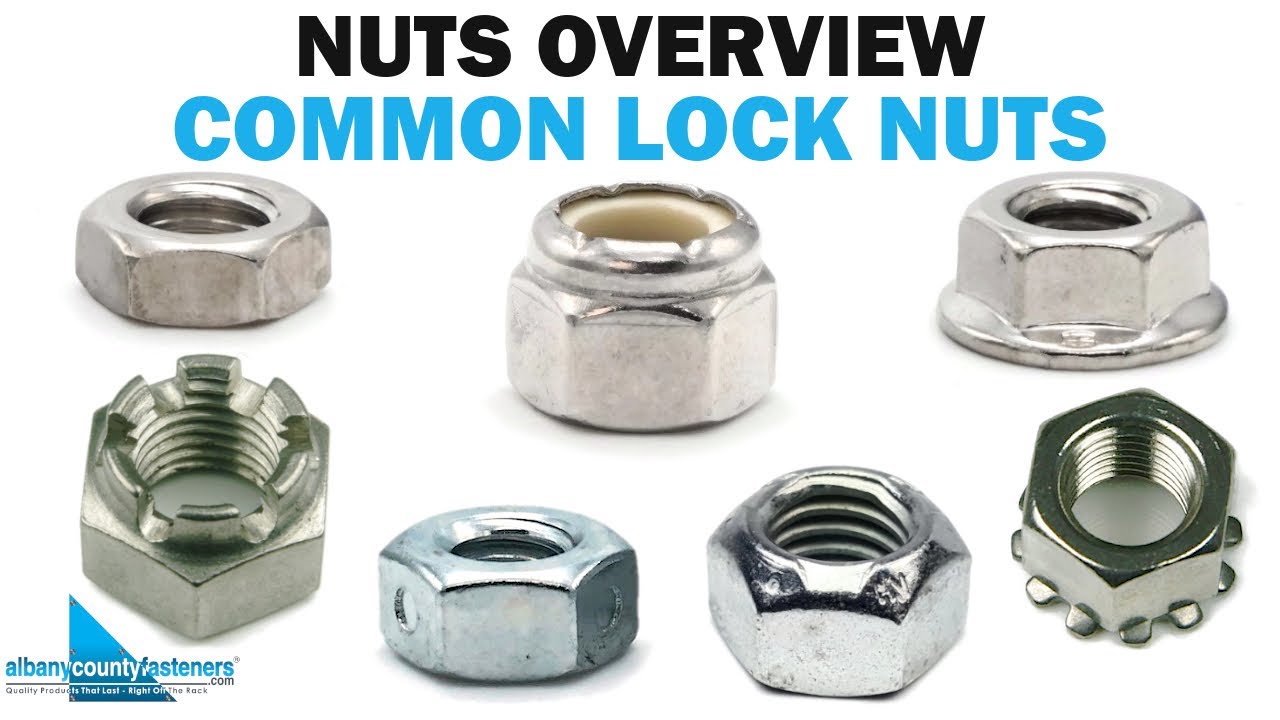
Choose an all-metal design when the verified temperature exceeds the insert’s capability, the chemicals are unsuitable for the polymer, or the application standard requires metal-only locking. Then control galling, coating, lubrication, running torque, and reuse.
Choose a nylon insert design when temperature and chemical exposure are compatible, a visible locking element is useful, and the specified torque behavior meets the joint requirement. Then protect the insert from heat, contamination, rapid installation, and unauthorized reuse. TNHO’s nyloc lock nut guide covers insert-specific details, while lock nut versus hex nut explains when a prevailing-torque feature is appropriate at all.
Provide the selected standard and type, thread size and pitch, tolerance, property class, nut and bolt materials, coatings, lubricant, proof-load requirement, installation torque or tension target, prevailing-torque limits, mating bolt definition, temperature profile, chemical exposure, vibration environment, installation speed, reuse cycle, inspection plan, traceability, and quantity. If comparing both options, ask for representative samples and test both under the same controlled conditions.
Document why the winning option was selected. A short decision record—temperature passed, chemical compatibility confirmed, torque band met through the required cycles, no galling, correct thread fit, and assembly test passed—is far more useful than a preference for “metal” or “nylon.”
No. Both designs can provide prevailing torque, but vibration performance depends on the complete joint, preload, mating threads, installation, and the applicable test. Select and validate the nut for the actual assembly.
Only within the verified limit for the insert and governing standard. Heat can alter polymer behavior. When temperatures exceed that limit, an approved all-metal design or another locking method may be required.
There is no universal cycle count. Both mechanisms change with use. The permitted number of cycles and minimum removal torque must come from the standard, supplier data, and application qualification.
Often yes, because applied torque must also overcome prevailing resistance. Establish the tightening method with representative hardware so the required preload is achieved without overstressing the bolt or joint.

 TNHO
TNHO 


