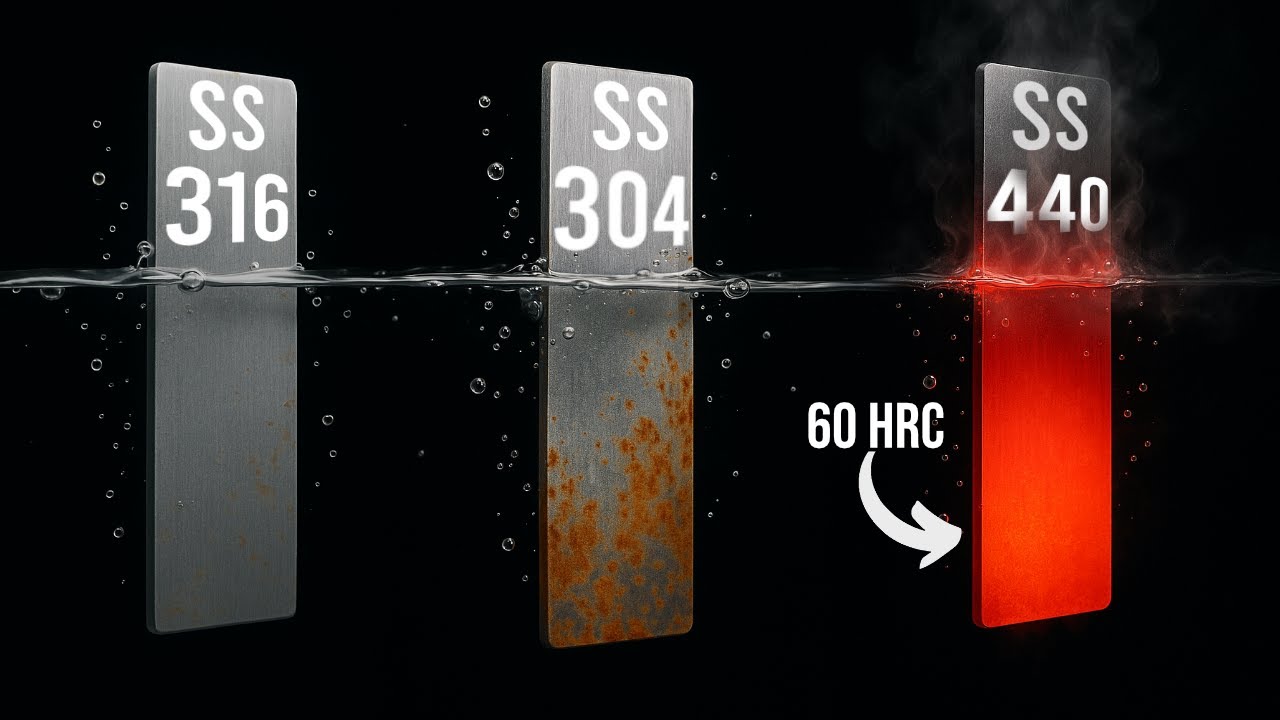
A2 vs A4 stainless steel fasteners is primarily a choice about corrosion environment and the exact fastener specification, not a way to judge screws by their shine. Under the ISO 3506 family, A2 and A4 identify austenitic stainless fastener grades; A4 contains molybdenum and is generally the more suitable starting point when chloride exposure is more severe. A2 is often adequate for ordinary indoor and less aggressive outdoor conditions. Neither designation by itself promises immunity from corrosion or gives the complete mechanical property class. On a purchase order, specify the grade together with a property class, thread, dimensions, finish and required evidence.
The letter and number identify a stainless fastener grade in the ISO system, not a finished screw’s exact performance in every environment. A designation such as A2-70 or A4-70 adds a property class; the “70” is not the same thing as the “2” or “4” in the alloy grade. Do not order “stainless” alone and assume the supplier will infer an A2 or A4 grade. The current ISO 3506-1:2020 covers mechanical and physical properties for bolts, screws and studs within its stated scope. Check whether the intended part geometry and size fall within that scope and what test or marking provisions apply.
Buyers often translate A2 to 304 and A4 to 316. That shorthand is helpful for understanding common alloy families, but it is not a complete material certificate or a one-to-one substitution for every product. The British Stainless Steel Association’s fastener-grade guide compares ISO grades with familiar bar-stock designations and emphasizes that selection is governed by the standard and service. Ask for the specified ISO fastener grade and class rather than accepting only “304 equivalent” on a quotation.

Stainless steel resists many environments because chromium forms a passive surface film. Chlorides can locally disrupt that film and cause pitting or crevice attack. Molybdenum in the common A4/316 family improves resistance to this type of attack compared with the common A2/304 family. The BSSA corrosion introduction explains this mechanism. The improvement is relative: neither A4 nor 316 is universally safe in seawater, a stagnant chloride-containing crevice, an aggressive chemical or a heated humid enclosure.
Exposure is not a single label. An outdoor electrical cabinet might see intermittent rain but little salt, or it might stand near a salted road or marine splash zone. A fastener under a washer, gasket or seal can retain moisture even when the visible head dries. Temperature, cleaning chemicals, deposits, drainage and dissimilar mating metals also change risk. If corrosion would impair electrical safety or access to a sealed assembly, have a corrosion specialist review the actual service conditions rather than choosing from a generic “indoor/outdoor” chart.
| Condition to review | A2 starting point | A4 starting point | What to verify |
|---|---|---|---|
| Dry indoor enclosure | Often suitable after design review | May be unnecessary unless another requirement governs | Grade/class, electrical interface, finish, service life |
| Occasional exterior wetting without salt | Evaluate drainage and crevices | Consider where retained moisture raises risk | Actual environment, cleaning and maintenance |
| Road salt or coastal deposition | Do not assume sufficient | Usually a more defensible starting point | Chloride level, temperature, crevices and corrosion test plan |
| Continuous seawater or aggressive chemical | Not a default choice | Not automatically adequate | Specialist grade selection and documented qualification |
This qualitative table is a screening tool, not a corrosion-rate guarantee. BSSA’s seawater selection guidance discusses how location and surface condition influence behavior. Local testing or a documented service record is more useful than assuming “marine grade” means permanent immunity.
Do not interpret A4 as automatically stronger than A2. Mechanical performance depends on the specified property class, product geometry, manufacture and testing condition. A2-70 and A4-70 are comparisons at the same nominal class; A4-80 and A2-70 are not equivalent just because both are austenitic. Also check the mating thread, preload method and risk of galling. A nominal material substitution may change installation behavior even if the geometry appears identical.
Stainless screw threads can seize during assembly, particularly when similar materials mate under high pressure. Control surface condition, lubrication or anti-seize where permitted, torque procedure and tool alignment. Do not copy a torque value from a carbon-steel joint into a stainless joint without validating friction and preload. For a critical bolted connection, testing of the assembled joint is more meaningful than treating an alloy name as a complete design.

Give the complete drawing, including fastener grade and property class, thread and tolerance, head/drive, length, surface condition and any passivation requirement. Identify the mating material and environment. If a certificate is required, state the document type, traceability level and test results expected. The supplier should not have to guess whether “316 screw” means an ISO A4 class, a particular national material designation or a decorative finish. For custom parts, confirm whether cold forming or machining is planned and how the finished part will be identified or segregated by grade.
TNHO’s meter housing screw family lists 304 stainless and brass options. That page shows relevant product geometry, but it does not itself establish that an A4 version has been qualified or is stocked. Ask for a specific A4 quotation and supporting documentation when the exposure analysis calls for it. Related fastener choices include 304 versus 316 screw selection for alloy-focused detail, head access and thread engagement. These are separate design questions.
Inspect marking where the product standard and geometry require or permit it, but do not treat a missing head stamp on a tiny screw as proof of a wrong material. Check the purchase order, certificate, lot identification and packaging segregation. Positive material identification can help where mix-up risk is high, but its method and detection limits must match the alloy distinction and specification; an instrument result alone does not establish the mechanical class. Verify dimensions and thread fit independently of material. If passivation is specified, request process documentation and the agreed verification instead of inferring it from a bright surface.
For a mixed hardware kit, keep A2 and A4 bins separately identified at receiving, storage and the assembly line. A visually similar screw can enter the wrong kit after a repack or a service repair. Link bag labels and certificates to the order and lot, then perform the agreed sample checks on the actual delivered components. If head marking is impractical because the part is small or customized, agree in advance on another identification and traceability method. This is a purchasing control, not a claim that one grade is universally superior.
For returned or corroded parts, record the location of attack: visible heads, thread roots, under washers or within a blind hole. Photograph deposits and the mating materials before cleaning. A localized failure at a crevice may require design drainage or a higher alloy rather than a simple A2-to-A4 substitution. A broad discoloration might require investigating contamination or cleaning chemistry. Keep failed samples and lot records so the diagnosis is evidence-based.
“A4 is always rustproof.” No stainless grade is immune in all environments. “A4 is stronger.” Grade and property class are different controls. “A2 looks different from A4.” Visual appearance is not a reliable alloy test. “316 and A4 are identical words.” They refer to related but different designation systems. “The screw alone determines corrosion risk.” Crevice geometry, water retention, cleaners and the mating parts matter as well.

This independent mechanical-design education video explains stainless families and includes a 304-versus-316 section. It is background for why alloy chemistry changes corrosion behavior, not a substitute for ISO 3506 acceptance or project qualification.
They are commonly compared, but specify the applicable fastener grade and property class rather than assuming the alloy shorthand is a complete purchase specification.
A4 is often the more suitable starting point for chloride exposure, but actual salt deposition, temperature, crevice design and service life determine whether it is sufficient.
No. Use traceable documents and a suitable material verification method when required. Surface finish or color is not proof.
Both specify the same nominal property-class designation under the relevant standard, but verify the actual product, scope and project requirements rather than assuming an unrestricted substitution.

 TNHO
TNHO