Set Screws are special types of fasteners used to lock two pieces together (or separately) without using a nut or other attaching device. Set screws are generally all-threaded and rely on their thread design to provide a strong connection. They can be small but using set screws will enable you to have a strong and permanent connection when you have limited room to use other types of fasteners or if the design limits your ability to use other types of fasteners. Set Screws tighten directly on to the surface of the part(s) being retained resulting in a secure and dependable attachment. Because of this unique feature of Set Screws they are commonly used in a wide variety of industries and mechanical applications and are used in many instances that require both versatility and simplicity.
Set screws function by embedding their threaded shaft into an object and applying pressure to hold an object in place. Generally, the set screw is driven by either a wrench or screwdriver and the tightening of the set screw produces friction and compression that prevents movement between the parts that are joined together. Therefore, set screws are commonly used in applications such as securing gears and pulleys to shafts because they are able to provide a secure connection that allows for mechanical rotation without causing the gear or pulley to slip.
Set screws have one primary distinguishing characteristic; they have been engineered to lie either flush or slightly recessed from the surrounding surface to provide a smooth finish to the assembled parts. Therefore, there are no protruding elements as there would be with traditional bolts or screws (which require a secondary locking device). These design features are essential in multiple industrial applications and engineering applications.
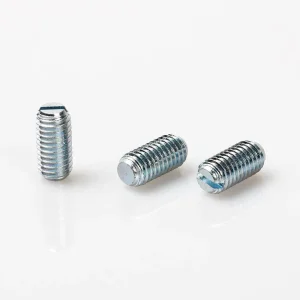
Set screws provide a wide range of benefits. Below are some key advantages:
Space-Friendly Design: With their low-profile design, these provide space-saving possibilities in applications where space is limited or at a premium. Thus, there is no technical requirement to use “nuts” on top of the load-rated point; this eliminates the need for extra hardware, which is particularly important in generating available space for components.
Flexibility: The ability to adjust, take off and reposition set screws makes them helpful when you need to make modifications within a project.
Securely Held: Set screws that have been installed correctly will provide good gripping strength and will hold up against vibration forces, while still holding its position no matter how challenging the environment may be.
Various Materials Go Well Together With Set Screws: Set Screws Can Be Used To Secure Many Different Material Combinations—These Include Steel, Aluminum, And Plastics—Making Them Attractive Choices Across Multiple Industries.
Positioning fasteners are important in industrial and mechanical applications. Set Screws can be useful in numerous different industries such as; automotive, aerospace, large machinery, etc. Engineers and manufacturers use set screws to secure and assemble important features of machines, locking collars, attaching gears/pulleys, and many more uses while remaining strong and easy to install.
The main reason that fasteners are so popular is that they are capable of providing a great deal of precision and reliability during use, for example: when fasteners are installed in a rotating assembly such as a shaft (or motor) – they give the required holding force with little damage to the surfaces they are attached to. In addition, fasteners can also be very versatile, which often makes them more economical than complicated fastening solutions.
There are numerous kinds of set screws, each designed for a different application. Below are some of the most common types of un-used screws along with various attributes associated with these particular categories.
There are many types of set screws, making it easy to find a suitable solution for most applications, from precision machinery to general industrial applications.
How a set screw is put together depends a lot on how you are going to use it. You can use the following examples as guides:
Set screws certainly have practical purposes and can be found across a wide range of different fields. Below are just a few of the popular ways people utilize them:
Locking Rotating Parts: Many types of industrial machinery use set screws to lock down parts such as belts and pulleys, as well as rotating shafts and components.
Adjustable Fixations: These fixtures use screw locks that enable adjustment without disassembly; thus, they are an integral part of adjustable assemblies.
Collar Locking: Set screws are utilized for locking collars to stabilize collars and prevent sliding or movement of any components/machinery on the axis of a shaft.
Pulleys & Bearings: These hold the mechanical units or parts securely. Therefore, they can operate correctly, with respect to alignment.
Smaller set screws are used in medical devices to assist with both assembling and adjusting complex instruments as well as helping with all types of implants.

There are many different factors that should be considered when selecting a proper set screw, such as the materials of the items to be fastened together, the amount of torque needed for use, and what the intended purpose is. In addition to those three basic considerations, consider these other elements as well:
Select set screw materials based on your specific needs. For example, if you want to avoid rust, stainless steel is best; if you need a lot of strength, alloy steel is ideal.
Select the right type of screw, e.g., use a flat point screw for delicate surfaces and a cone point screw if you want something that will not move later on.
The size and thread of the bolt being selected must be compatible with the components being fastened together. The manufacturer’s sizing charts can often provide assistance in determining whether the appropriate size and thread have been selected.
If you think about all these things carefully, you will be able to improve both the strength and reliability of your mechanical assemblies.
Set screws play a vital role in today’s engineering and construction industries because of their versatility, simplicity, and reliability. The way you use set screws largely depends on what application they are being used for, but selecting an appropriate type or material is just as important to ensure that you achieve the best results, whether you are attaching parts together in a highly technical machine or completing a do-it-yourself project. Careful consideration about your specific needs will lead to utilizing set screws as essential resources in your project.

 TNHO
TNHO 


