Stepped shaft protective packaging should keep critical surfaces from contacting neighboring parts, prevent movement that damages small projections, and retain the part’s identity through unpacking. Start with the shaft drawing and the real shipping route, then choose the supports, separators and outer container together. A soft-looking liner or an attractive tray is not evidence that the finished package protects the required geometry.
This guide addresses small custom shafts moving between a supplier, stores and an assembly cell. It does not assign a universal foam density, preservative or transport test. Those choices need the actual part requirements, packaging compatibility and an agreed acceptance plan.
The TNHO shaft, cotter pin and contact pin product family includes the small stepped shaft illustrated here. The reference has a hexagonal main section, cylindrical transitions, a short longitudinally textured band and a reduced smooth tip. One view shows a small axial opening at the larger end. These visible features do not establish dimensions, material, electrical function or the allowable shipping load.
Use the approved drawing to identify the surfaces that locate, slide, engage or contact another component. Mark where packaging may support the shaft and where pressure or rubbing is restricted. A support on the robust main section may be appropriate for one design and wrong for another; the photograph cannot establish that decision.
Begin with the information in the shaft and contact pin RFQ evidence checklist. Add the delivery condition and packaging requirements to the same configuration record. The order should describe the item that must arrive, not just the loose part that left the machine.
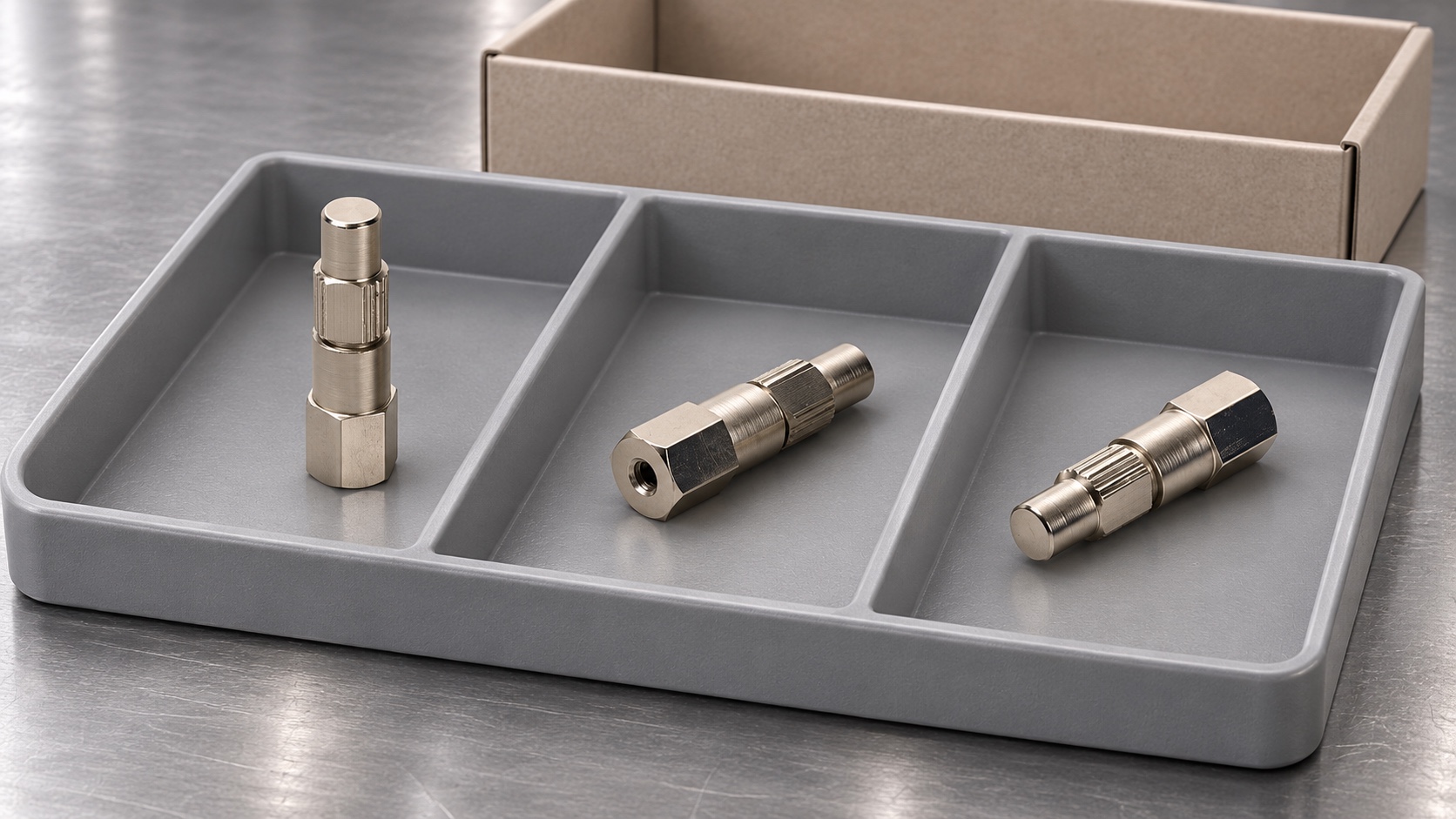
There are two different problems to solve. Parts can rub or strike each other inside a container, and the entire inner package can move inside the outer box. A divider addressing the first problem may do little about the second. Conversely, tightly filling the outer box does not stop two shafts touching within a loose inner bag.
Consider how the package behaves when lifted, turned or placed down along the actual route. A tray that separates parts while horizontal may allow them to cross compartments when tilted. A lid can restrain movement, but its contact must not push on a reduced tip or create unwanted marks. Document the closure arrangement rather than relying on a photograph of an open tray.
The Canadian Conservation Institute’s physical forces guidance explains general mechanisms such as impact, vibration and contact damage. Its context is cultural objects, not qualification of industrial shafts. The limited transferable principle is to consider the object, supports and container as a system; it supplies no approved packaging dimensions for this TNHO reference.
Decide which part features will bear against the package. Where the drawing identifies a sensitive surface, provide separation or a compatible barrier rather than assuming that a soft material cannot damage it. Abrasive particles trapped between a liner and a finished surface can defeat an otherwise sensible support arrangement.
Avoid supporting an assembly of parts by their smallest projections simply because those features fit neatly into a hole. Review whether closure, stacking or transport movement can load a reduced tip. The support should follow the approved geometry and handling requirements, including the intended way to remove the shaft without levering it against the tray.
A formed pocket, divided tray, individual wrap or another method may be suitable, but none is universally correct. Compare alternatives against the real failure mechanism: part-to-part contact, rubbing at a support, movement into a wall, loss of identity or contamination. Choose the simplest arrangement that addresses the identified risks and can be packed consistently.
An internal trolley journey and a multi-stage courier shipment can require different protection. Record the likely handling stages, storage intervals, repacking points and environmental concerns. Include transfer from the supplier’s shipping carton to local picking containers; that transfer may remove the original protection long before the shafts reach assembly.
Ask who opens each package, how many parts are removed and what happens to the remainder. If the packaging is opened repeatedly, a one-time closure may be impractical or lead to improvisation. A returnable tray needs an inspection and cleaning decision before reuse, not an assumption that every empty tray is ready for another lot.
Keep orientation identification visible through this route where it matters to the receiving task. The stepped shaft end-orientation guide addresses the distinguishing features. Packaging should preserve that information without applying unauthorized marks, adhesive or force to the part itself.
The following table is a planning aid. It does not prescribe a cushioning specification or prove that a package has passed transport testing.
| Packaging concern | Feature or route to review | Control to define | Evidence to retain |
|---|---|---|---|
| Part-to-part contact | Adjacent shafts and compartment boundaries | Separation that survives handling | Pack layout and represented quantity |
| Projection loading | Reduced tips and small transitions | Approved support and lid contact locations | Drawing-linked feature review |
| Surface rubbing | Functional faces and textured bands | Compatible contact material and restraint | Material identity and trial observations |
| Inner-package movement | Tray or bag inside the outer container | Positioning and closure arrangement | Complete pack configuration |
| Loss of identity | Split deliveries and partial cartons | Transferable part and lot identification | Issue, transfer and repack record |
Assign a person to resolve each open item. A packaging instruction becomes useful when it tells the packer which arrangement to reproduce and tells receiving what evidence should accompany it. A generic instruction to “pack carefully” supplies neither.
Mechanical protection and corrosion prevention are different requirements. A divider may prevent contact while doing nothing about a moisture-sensitive shipping route. A corrosion inhibitor may address another concern while leaving the shafts free to strike one another. Evaluate both without treating either as a universal solution.
Do not add oil, an inhibitor, adhesive tape or a cleaning treatment without approval for the supplied surface and intended use. The reference’s color does not establish a material or finish, and the term contact pin does not automatically define the function of this particular shaft. Obtain compatibility requirements from the actual drawing and customer specification.
The NASA fastener procurement and storage publication provides mission-hardware background for controlling delivered condition and identity. It does not certify the illustrated shafts or identify a preservative for them. For ordinary stock-area considerations, use the separate fastener storage guide alongside the route-specific shipping plan.
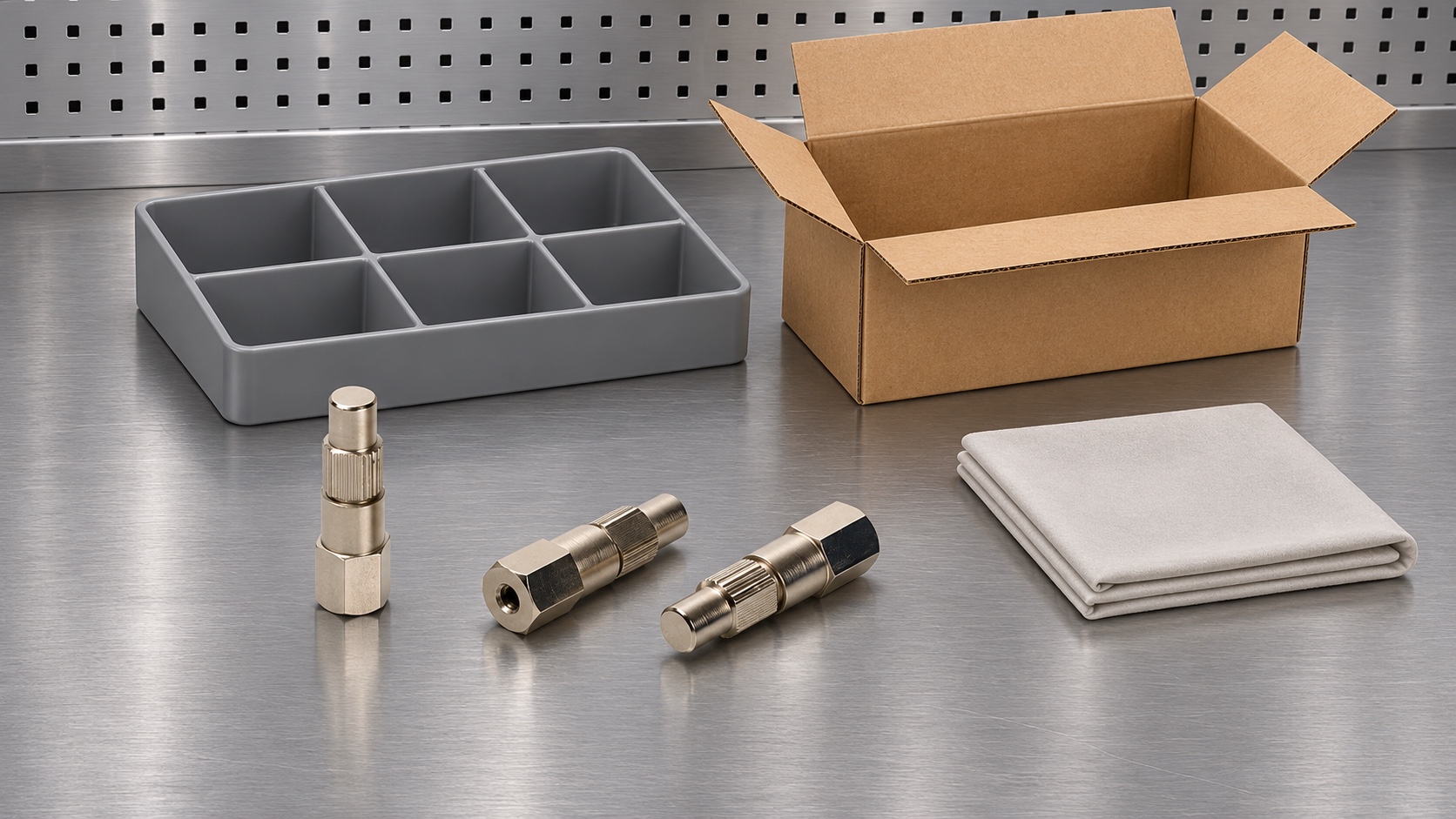
Review the actual proposed quantity, arrangement, supports, closures and outer container together. Testing an empty tray or a single loosely wrapped shaft does not represent a full pack. Record any substitutes used in a trial and explain what the trial can and cannot demonstrate.
Agree the evaluation method and acceptance criteria before the trial. They may include the required surface condition, geometry, part identity and absence of prohibited contact. The relevant customer or packaging specification determines the transport exposure and examination. Do not invent a drop height or vibration duration merely because it appears in a general online example.
After the agreed evaluation, inspect both the parts and package. A damaged divider can indicate loss of separation even when the most visible shaft looks acceptable. Conversely, a tidy outer carton does not establish the condition of internal tips or contact surfaces. Keep observations linked to the pack configuration and sample identities.
Provide an opening method that avoids pulling on projections or cutting close to the parts. Tell receiving how the shafts should be supported when lifted from the package. Identify which packaging components may be reused, which need inspection and which should be replaced after opening.
If a receipt is damaged, document the outer and inner condition before discarding the packaging. Keep the affected shafts distinguishable while the responsible person reviews the incident. Do not polish away a contact mark or straighten a projection informally, because that changes the condition that needs evaluation.
For a partial issue, retain the original part and lot identity with the remaining stock and the newly filled picking tray. A protective container without the correct identity is incomplete delivery control. Review the handoff using the actual packer and receiver instructions so protection does not disappear at the first convenient repacking point.
The packaging record should identify the part revision, quantity per inner pack, support arrangement, materials, closure and outer container. Include photographs as an aid to reproduction, while keeping dimensional or material requirements in the controlled instruction. Photographs alone cannot specify an unseen liner or a closure force.
Review changes that can affect performance: a different tray supplier, altered compartment geometry, larger quantity, changed transport route or a revised shaft feature. The accepted package supports only the configuration and conditions actually evaluated. Keeping that boundary explicit helps procurement make substitutions without silently losing the protection the design relied on.
NPTEL IIT Guwahati’s “Lec 27: Material handling systems” provides an educational view of material movement through production. Use it to consider the transfer points surrounding the package. It does not approve a cushioning material or transport qualification for these shafts.

Only if the approved requirements and evaluation permit the resulting contact and movement. Similar size and low weight do not establish that functional surfaces or small projections will remain protected.
No. Its compatibility, contact location, restraint and behavior in the complete package matter. A liner can still trap debris, allow movement or load a sensitive projection.
No universal treatment should be assumed. Confirm the material, supplied finish and downstream compatibility requirements. Apply only the preservation method approved for the actual configuration.
No. Follow the receiving requirements for the inner pack, part condition and identity. The outer appearance alone does not establish that internal contact, movement or loss of separation did not occur.


 TNHO