
 TNHO
TNHO In industrial manufacturing, fasteners play a critical role in assembly strength, product safety, maintenance efficiency, and long-term reliability. Common types of fasteners include screws, bolts, nuts, washers, rivets, studs, pins, clips, inserts, and custom non-standard fasteners. Although these components are often small, their material, thread design, dimensional tolerance, surface treatment, and production consistency can directly affect the performance of the entire assembly.For OEM manufacturers, electrical equipment producers, automotive suppliers, power system companies, new energy equipment manufacturers, machinery builders, appliance brands, and construction hardware buyers, fastener sourcing is no longer limited to selecting standard parts from a catalog. Many projects require fastening components that match specific drawings, installation environments, torque requirements, corrosion resistance needs, and inspection standards.
Incorrect fastener selection may lead to thread mismatch, loosening, corrosion, deformation, rework, or assembly failure. This article explains common industrial fastener types, key specification parameters, custom manufacturing options, production considerations, quality assurance processes, and practical sourcing information for buyers preparing a custom fastener quote.
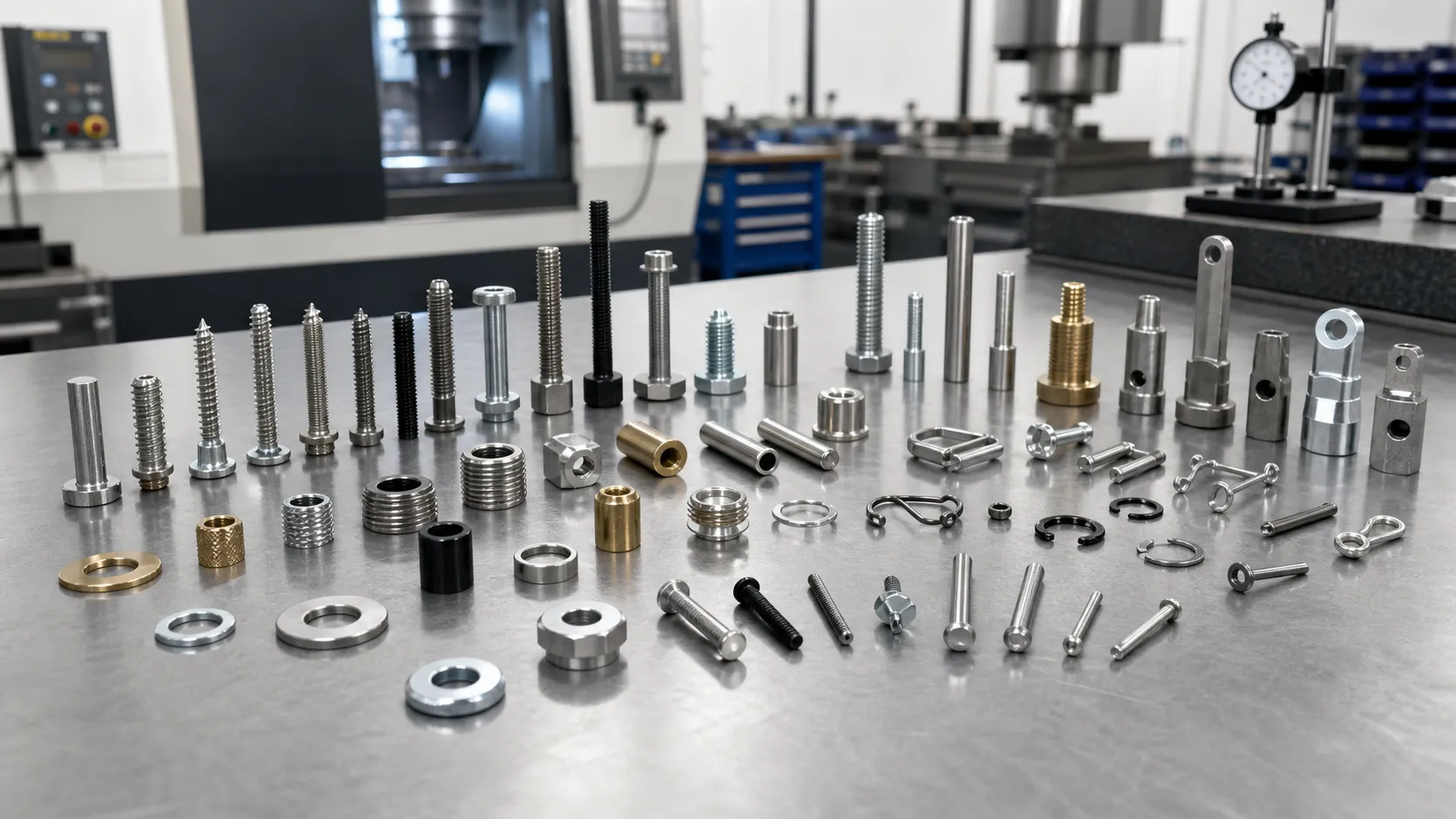
Common Types of Fasteners Used in Industrial Manufacturing
Industrial fasteners are used to connect, position, lock, support, or protect components in an assembly. The right fastener type depends on the product structure, load requirement, installation method, maintenance needs, and working environment.
In practical industrial applications, fasteners are usually selected based on their function:
- Removable connection: The use of screws, bolts, nuts and studs can help make assembly, disassembly and maintenance of a part easier.
- Permanent joining: Some unique kinds of pins and rivets work when a connection doesn’t need disassembling during everyday usage.
- Positioning and alignment: Assembly pins, stud-like fixtures, and custom locating pins assure proper alignment as well as correct placement of components during manufacture or assembly.
- Load distribution and protection: Washers help spread tightening force, reduce surface damage, and improve connection stability.
- Special functional needs: Fasteners, inserts, custom clips, and screws can serve a number of functions including but not limited to: providing insulation, locking, spacing, connecting electrical circuitry, and/or allowing for quick assembly.
Threaded Fasteners: Screws, Bolts, Nuts, and Studs
Threaded fasteners are among the most widely used fastening components in industrial manufacturing. Screws are commonly used in electrical equipment, household appliances, instruments, machinery covers, plastic housings, and metal enclosures. They are suitable for removable assembly and can support both manual installation and automated assembly.
Bolts and nuts are used where stronger mechanical connection is required. They are common in machinery frames, automotive parts, construction hardware, industrial equipment, and structural assemblies. A bolt and nut connection can be disassembled during maintenance, making it suitable for products that require inspection, repair, or replacement.
Studs are used when precise alignment, repeated assembly, or stable threaded positioning is needed. They are often found in engines, power systems, mechanical equipment, and assemblies where one end is fixed while the other end is used for connection. For threaded fasteners, thread size, pitch, material grade, strength level, and surface treatment must be carefully matched with the application.
Washers for Load Distribution and Surface Protection
Washers help distribute load, protect assembled surfaces, and improve fastening stability. In machinery, electrical cabinets, construction parts, and equipment assemblies, washers are often used together with screws, bolts, or nuts.
Some washers are designed for locking, sealing, insulation, or vibration resistance. Spring washers and lock washers help reduce loosening risks, while insulating washers may be used in electrical applications. Material, thickness, inner diameter, outer diameter, and surface finish all affect washer performance in the final assembly.
Rivets, Pins, Clips, and Inserts
Rivets are used for permanent or semi-permanent joining, especially in sheet metal assemblies, housings, panels, appliances, and transportation equipment. They are useful when welding is not suitable or when a clean mechanical joint is preferred.
Pins are mainly used for positioning, alignment, or load transfer. Clips provide quick installation and holding functions, especially in automotive interiors, electrical devices, plastic parts, and appliance assemblies. Inserts are used to strengthen internal threads in plastic, soft metal, or thin sheet materials, helping reduce thread stripping during repeated installation.
Custom and Non-Standard Fasteners
Standard fasteners can meet many general assembly needs, but industrial projects often require customized solutions. Custom fasteners and non-standard fasteners are used when standard products cannot meet required size, strength, space, material, appearance, or installation conditions.
OEM projects may require special screws, custom bolts, non-standard nuts, stepped pins, threaded inserts, electrical connection parts, or irregular-shaped fastening components. These parts may perform more than one function, such as fastening, positioning, supporting, conducting, locking, or spacing. In these cases, fastener design should be reviewed together with the product structure and working environment.
Key Specifications Buyers Should Confirm Before Ordering
For industrial buyers, fastener purchasing should begin with clear technical requirements. Two fasteners may look similar, but their performance can differ greatly if the material, thread, tolerance, hardness, or coating is different. Clear specifications help suppliers evaluate feasibility, reduce communication errors, and prepare accurate quotations.
Before confirming an order, buyers should pay attention to the following factors:
- Application environment: The environment will influence the type of material and finish selected, whether it be indoors, outdoors, humid, chemical, high heat or vibration conditions.
- Assembly method: Electrical tools, manual installations, and/or completely automated assembly lines may all require different types of heads, types of drives, and tolerances.
- Mechanical performance: For safety-critical or heavy-duty applications, you must verify that the product meets the required load, torque, tensile strength and hardness values.
- Corrosion resistance: The coating type and coating thickness along with the salt fog test need to be established for use in outdoor or difficult conditions.
- Documentation needs: OEM projects often require material delivery documentation such as Material Certification, inspection reports, coating reports, and batch traceability documentation.
Material, Strength, and Application Environment
Material selection affects strength, corrosion resistance, electrical performance, weight, service life, and cost. Carbon steel is often used for general mechanical applications and cost-sensitive projects. It is usually combined with zinc plating, black oxide, or other surface treatments to improve corrosion resistance.
Alloy steel is suitable for high-strength and heavy-duty applications such as automotive parts, machinery components, and structural assemblies. Stainless steel is preferred for outdoor, humid, chemical, marine, or corrosion-prone environments. Brass is often used in electrical components because of its conductivity and corrosion resistance. Aluminum is useful for lightweight assemblies, while nylon, POM, and PP are used for insulation, corrosion resistance, and weight reduction.
A fastener used inside an electrical cabinet has different requirements from one used in outdoor power equipment, new energy systems, or high-vibration machinery. Temperature, humidity, chemical exposure, load, and maintenance frequency should all be considered during material selection.
Note: For carbon steel and alloy steel fasteners, mechanical property classes such as 8.8, 10.9, and 12.9 are commonly defined according to international standards such as ISO 898-1. These grades help buyers evaluate tensile strength, yield strength, hardness, and suitability for load-bearing applications.
Thread Size, Diameter, Length, and Tolerance
Thread size and pitch determine whether a fastener can assemble correctly with the mating part. Incorrect thread specifications can cause loose connections, thread damage, installation failure, or rework. Buyers often need to confirm nominal diameter, pitch, thread length, and tolerance class.
Diameter and length also affect assembly reliability. If a fastener is too short, it may not provide enough thread engagement. If it is too long, it may interfere with other components or create installation problems. In precision equipment, electrical instruments, automotive components, and automated assembly lines, tolerance control is especially important for smooth assembly and stable torque performance.
Head Type, Drive Type, and Surface Treatment
Head type affects appearance, bearing area, clearance, and installation method. Common head types include pan head, countersunk head, hex head, flange head, round head, and custom head designs. Drive type affects torque transfer and assembly efficiency, with options such as Phillips, slotted, hex socket, Torx, square drive, and special drives.
Surface treatment improves corrosion resistance, appearance, wear resistance, or electrical properties. Zinc plating, nickel plating, black oxide, passivation, phosphating, electrophoresis, and other coatings may be used depending on the application. For outdoor equipment, power systems, new energy installations, and humid environments, coating thickness and salt spray resistance are often important purchasing factors.
Technical Reference: Zinc plating and other electroplated coatings are often evaluated according to standards such as ISO 4042 or ASTM F1941/F1941M. For buyers sourcing fasteners for outdoor or corrosive environments, coating specification, thickness, and corrosion test requirements should be confirmed before production.
| Specification | Buyer Focus |
|---|---|
| Material grade | Strength, corrosion resistance, conductivity, cost |
| Thread size and pitch | Assembly compatibility and torque performance |
| Diameter and length | Fit, engagement depth, load performance |
| Tolerance | Dimensional consistency and automated assembly |
| Surface treatment | Corrosion resistance, appearance, durability |
| Inspection requirement | Quality control and documentation |
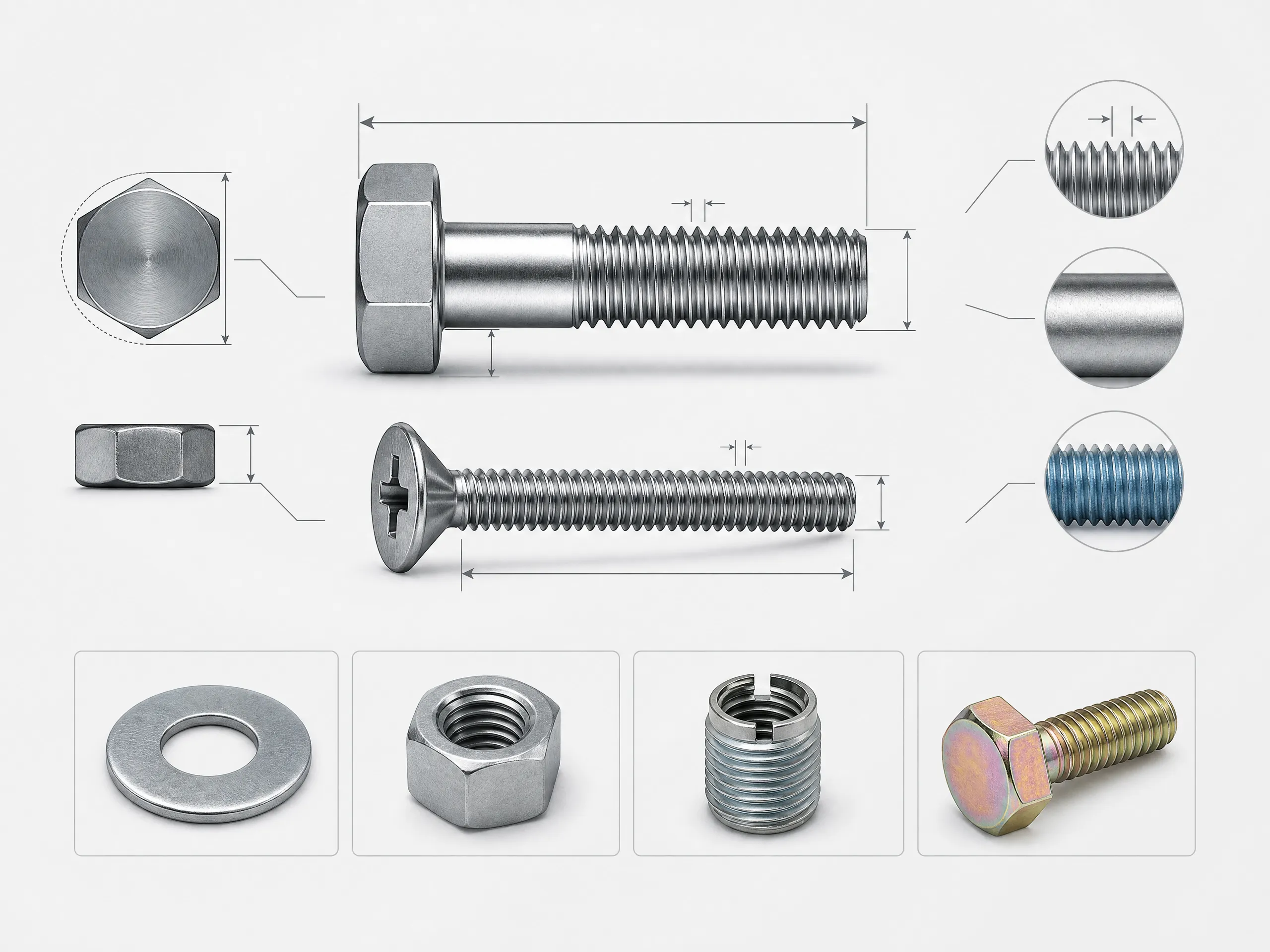
When Standard Fasteners Are Not Enough
Many manufacturers begin with standard fasteners because they are easy to source and suitable for general applications. However, when product design, installation space, load requirement, or operating environment becomes more specific, standard parts may no longer be the best choice. In these situations, OEM fasteners, custom fasteners, and non-standard fastening solutions become important.
Modified Standard Fasteners
Some projects only need small changes based on existing standard parts. A screw may need a different length, special head shape, modified drive type, shorter or longer thread section, or specific coating. A washer may need a different thickness or outer diameter. A bolt may require special surface treatment or customized packaging.
Modified standard fasteners can reduce development time while still meeting project-specific requirements for fit, appearance, corrosion resistance, or installation efficiency.
Fasteners Made to Drawing
For OEM manufacturing, fasteners made to drawing are common. A technical drawing usually defines geometry, dimensions, tolerances, material grade, thread specification, heat treatment, surface treatment, and inspection requirements. With a complete drawing, the fastener manufacturer can review production feasibility and select a suitable process.
Made-to-drawing fasteners are widely used in automotive components, electrical equipment, power systems, industrial machinery, new energy products, and non-standard devices. These industries often require stable quality, batch consistency, and supporting documents such as material certificates or inspection reports.
Sample-Based Customization
When buyers do not have a complete drawing, a physical sample can help the manufacturer understand the part structure and evaluate whether it can be reproduced or improved. This is common for replacement parts, legacy equipment, imported equipment maintenance, or irregular fasteners.
However, sample-based customization still requires technical clarification. Material grade, hardness, surface treatment, tolerance, thread standard, and application conditions should be confirmed before production, especially for load-bearing or safety-related parts.
Irregular-Shaped Fastener Parts
Irregular-shaped fastening parts are used when a component must perform multiple functions, such as fastening, positioning, spacing, electrical connection, support, or anti-rotation. Examples include stepped parts, special pins, threaded inserts, custom bolts, non-standard nuts, electrical terminals, and complex metal fastening components.
These parts often require combined processes such as cold heading, drilling, tapping, machining, heat treatment, and surface finishing. For repeat production, mold or tooling development may improve consistency and efficiency.
From Technical Review to Production Planning
A reliable custom fastener project usually begins with technical review. Before production planning, buyers should provide drawings or samples, material grade, thread requirements, surface treatment needs, application environment, expected quantity, annual demand, inspection standards, and packaging details. This information helps manufacturers evaluate feasibility, recommend a suitable process, estimate tooling or sampling needs, and prepare a more accurate quotation.
During the review stage, the manufacturer checks whether the part structure is suitable for stable production. If the fastener has a simple shape and large demand, cold heading may be efficient. If the part has complex geometry, tight tolerance, or low volume, machining may be more suitable. Internal threads usually require tapping, while external threads are often formed by thread rolling.
Cold heading is widely used for screws, bolts, rivets, and similar fasteners. It forms metal wire into the required shape through pressure, making it suitable for high-volume production. Thread rolling creates external threads by forming rather than cutting, which helps improve thread consistency. Drilling is used for cross holes, positioning holes, or special structural needs.
Machining offers flexibility for complex custom parts but may have higher unit cost than forming processes. Heat treatment can improve hardness, tensile strength, and fatigue performance, while surface treatment improves corrosion resistance and appearance.
| Process | Suitable Products | Main Advantage |
|---|---|---|
| Cold heading | Screws, bolts, rivets | Efficient batch production |
| Thread rolling | External threaded parts | Stable thread quality |
| Tapping | Nuts, inserts, internal threads | Reliable thread fit |
| Machining | Complex custom parts | Flexible geometry |
| Heat treatment | High-strength fasteners | Improved mechanical properties |
| Surface treatment | Coated fasteners | Better corrosion resistance |
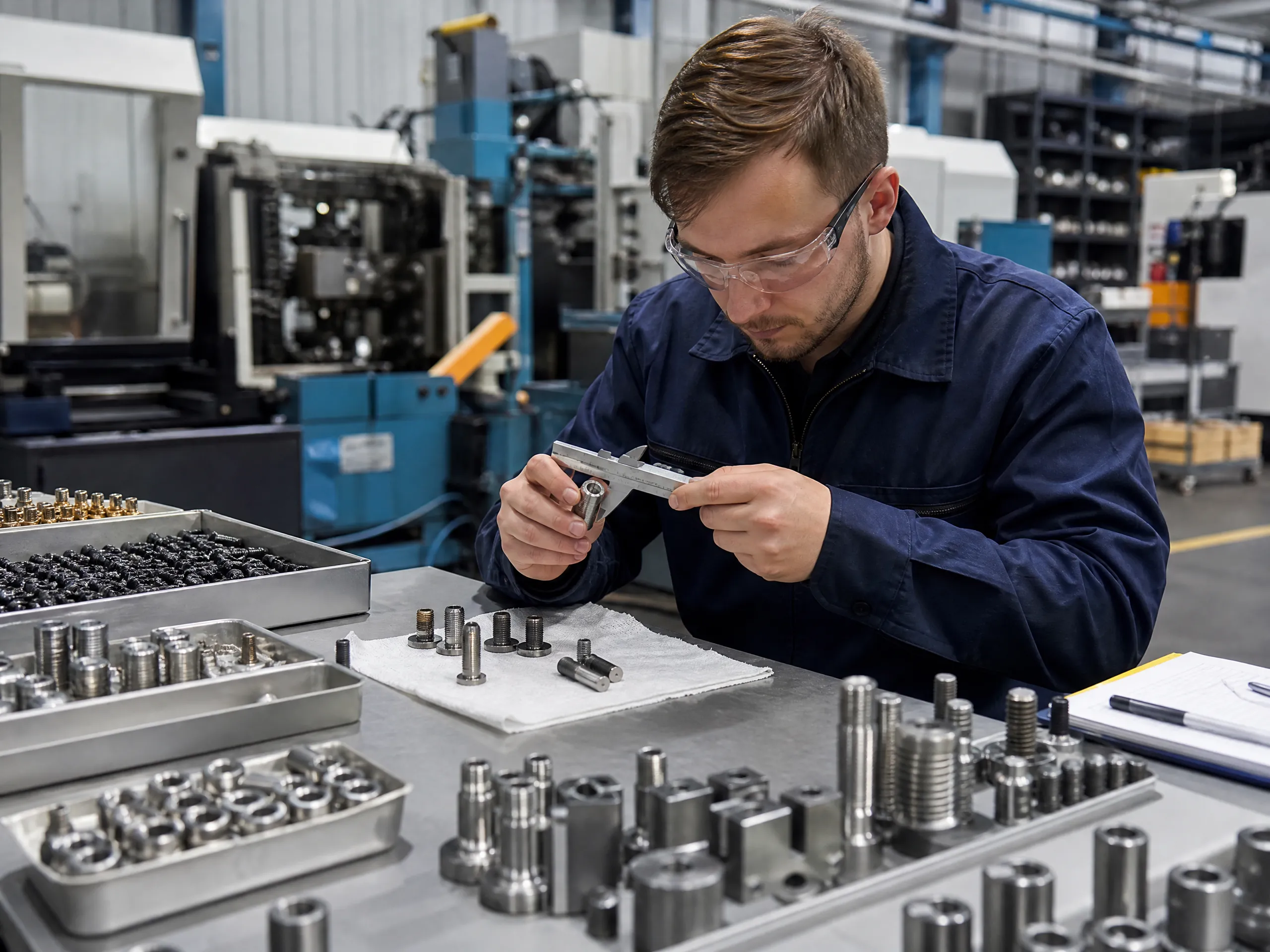
For suppliers such as Zhejiang Tianhong Fastener Co., Ltd., capabilities in cold heading, thread rolling, tapping, drilling, machining, mold development, inspection, testing, and warehousing can support both standard fastener orders and custom non-standard fastener projects. This integrated capability is useful for OEM buyers who need engineering communication, process planning, and stable batch production from one supplier.
Quality Assurance for Industrial Fasteners
Quality assurance is essential because fastener failure can affect the safety and reliability of the entire product. In industrial manufacturing, quality control should not depend only on final inspection. It should cover raw material inspection, first article inspection, in-process inspection, dimensional inspection, thread inspection, mechanical testing, surface treatment verification, and final packaging checks.
Raw material inspection confirms that the correct material is used before production begins. This is important because different grades of steel, stainless steel, brass, aluminum, or plastic can have very different mechanical and corrosion-resistance properties. For OEM and export orders, material certificates may be required to support customer approval and batch traceability.
First article inspection confirms whether the first produced parts match the drawing, sample, tolerance, thread requirement, surface condition, and key dimensions. During production, in-process inspection monitors dimensional variation, appearance, thread quality, and process stability.
Thread inspection is especially important for screws, bolts, nuts, studs, and threaded inserts. Poor thread quality may cause assembly difficulty, weak connection, or product rejection. Dimensional inspection ensures that the fastener fits the mating component, while mechanical testing may include hardness testing, tensile testing, torque testing, or load testing.
Surface treatment verification checks coating thickness, adhesion, appearance, and corrosion resistance. For outdoor equipment, new energy systems, power equipment, and humid environments, salt spray testing may be used to evaluate corrosion resistance. Quality documents such as inspection reports, material certificates, coating reports, and batch traceability records help buyers manage supplier approval and production control.
Packaging, Traceability, and Export Support
For OEM fastener purchasing, packaging is not only about transportation. Good packaging protects product appearance, prevents mixing, supports warehouse management, and improves assembly-line efficiency. Depending on customer requirements, fasteners can be packed in bulk cartons, small bags, labeled boxes, export cartons, pallets, or customer-specific packaging.
Traceability is also important for industrial buyers. Lot numbers, product labels, barcodes, and batch records help customers identify production batches and manage inventory. If a quality issue occurs, traceability makes it easier to locate the affected batch and take corrective action.
For export orders, packaging should consider moisture protection, carton strength, pallet stability, labeling requirements, and international logistics conditions. For OEM customers, customized labels, barcodes, and packaging formats can support smoother integration into their supply chain.
How to Prepare a Custom Fastener Quote Request
A clear quote request can significantly improve communication efficiency. When buyers provide complete information, the manufacturer can better understand the part function, review production feasibility, choose the right process, and calculate the cost more accurately.
A practical RFQ for custom fasteners usually includes:
- Drawing or sample: Technical drawing is preferred; a physical sample can be used when drawings are unavailable.
- Material and grade: These materials included: carbon steel, alloy steel, stainless steel, brass, aluminum, nylon and other materials specified in the order form.
- Dimensions and tolerance: Diameter, length, thread size, pitch, key dimensions, and tolerance requirements.
- Surface treatment: Coating specifications which include electroplated zinc, nickel-aluminun, black oxide, or passivity/phosphate finishes (or both) must be accounted for.
- Quantity and demand plan: Trial order quantity, mass production quantity, and estimated annual usage.
- Inspection and packaging: Requirements for testing, certification, labeling, packaging cartons, packing small packages, pallets and other types of custom packaging.
Incomplete information may lead to repeated communication, inaccurate pricing, unsuitable process selection, or delayed sampling. For example, a fastener used in indoor furniture may only need basic zinc plating, while a fastener used in outdoor power equipment may require higher corrosion resistance and salt spray testing. A low-volume prototype may be suitable for machining, while a high-volume OEM order may require tooling or cold heading to reduce unit cost.
Buyers preparing a custom fastener quote should also clarify whether the part is for prototype testing, replacement, mass production, or long-term OEM supply. Annual demand helps the manufacturer evaluate tooling investment, production planning, inventory support, and packaging method.
For customers who need made-to-drawing fasteners, non-standard screws, custom bolts, special nuts, threaded inserts, or irregular-shaped fastening parts, working with an experienced manufacturer can reduce sourcing risk. Zhejiang Tianhong Fastener can support OEM buyers with technical review, sample evaluation, process selection, production planning, inspection, and export-ready delivery.
FAQ: Types of Fasteners and Custom Fastener Solutions
1. What are the most common types of fasteners?
The most common types of fasteners include screws, bolts, nuts, washers, rivets, studs, pins, clips, inserts, and custom fasteners. They are used for joining, positioning, locking, supporting, or protecting components in industrial assemblies.
2. How do I choose the right fastener for my application?
The right fastener depends on load requirement, material, thread size, installation method, working environment, and maintenance needs. Buyers should also consider strength grade, tolerance, head type, drive type, and surface treatment.
3. When should I choose custom fasteners?
Custom fasteners are needed when standard parts cannot meet specific size, shape, strength, material, coating, or assembly requirements. They are commonly used in OEM projects, non-standard equipment, automotive parts, electrical systems, and industrial machinery.
4. What information is needed for a custom fastener quote?
Buyers should provide drawings or samples, material requirements, dimensions, thread specifications, surface treatment, quantity, application environment, inspection standards, and packaging needs. Complete information helps the manufacturer evaluate feasibility and provide an accurate quote.
5. What processes are used to manufacture custom fasteners?
Common processes include cold heading, thread rolling, tapping, drilling, machining, heat treatment, and surface treatment. The best process depends on the fastener design, material, tolerance, order quantity, and application requirements.
6. Why is quality control important for industrial fasteners?
Quality control helps prevent thread mismatch, loosening, corrosion, deformation, and assembly failure. It usually includes material inspection, dimensional checks, thread inspection, mechanical testing, surface treatment verification, and final inspection.
Conclusion
Fasteners may be small, but they play a critical role in industrial assembly reliability. Choosing the right types of fasteners, materials, thread specifications, tolerances, surface treatments, and manufacturing processes can help manufacturers reduce assembly risks, improve product quality, and support long-term equipment performance.
For standard applications, screws, bolts, nuts, washers, rivets, studs, pins, clips, and inserts may be sufficient. For more demanding OEM projects, custom fasteners and non-standard fasteners are often necessary to meet specific design, strength, corrosion resistance, installation, and inspection requirements.
Industrial buyers should evaluate not only product price, but also supplier capability, production process, quality control, documentation support, packaging, and traceability. For companies preparing a custom fastener quote or looking for reliable OEM fastening solutions, choosing a manufacturer with engineering communication, production experience, and quality assurance capability is essential for achieving reliable assembly and stable long-term supply.
References and Technical Standards
- ISO 898-1 — Mechanical properties of fasteners made of carbon steel and alloy steel — Bolts, screws and studs with specified property classes
Official ISO page: https://www.iso.org/standard/93478.html - ISO 4042 — Fasteners — Electroplated coating systems
Official ISO page: https://www.iso.org/standard/76192.html - ASTM F606/F606M — Standard Test Methods for Determining the Mechanical Properties of Threaded Fasteners, Washers, and Rivets
Official ASTM page: https://www.astm.org/f0606_f0606m.html - ASTM F1941/F1941M — Standard Specification for Electrodeposited Coatings on Mechanical Fasteners, Inch and Metric
Official ASTM page: https://www.astm.org/f1941_f1941m.html


