Flange nut thread protection transit packaging should prevent unwanted contact at the thread entrance, keep debris away from the internal thread and preserve the supplied surface condition through unpacking. Review the inner arrangement and outer container together. A bag that retains the correct quantity is not automatically a package that protects the thread or the flange face.
This guide addresses packaging decisions for a custom flanged nut moving from supplier to receiving and assembly. It does not prescribe a universal cap, preservative or transport test. Select those controls from the actual nut drawing, delivered-condition requirements and agreed shipping route.
The TNHO hex flange nut family includes the silver reference illustrated here. This variant has a broad circular flange, a lower hexagonal section, a round relief and another hexagonal section above it. An internal threaded opening is visible at the flange end. The source photograph does not establish its thread specification, useful depth, material or coating.
Obtain the drawing for the ordered variant before defining protection. Identify the thread entrance, required flange contact area and any surfaces where marks or residue are restricted. Do not assume that a large exterior means that the internal thread can tolerate uncontrolled impacts from neighboring parts or packaging components.
The flange nut selection guide covers the broader family. Here the question is how to preserve an already specified delivery condition, not how to qualify a different nut or establish the strength of the joint in which it will be used.
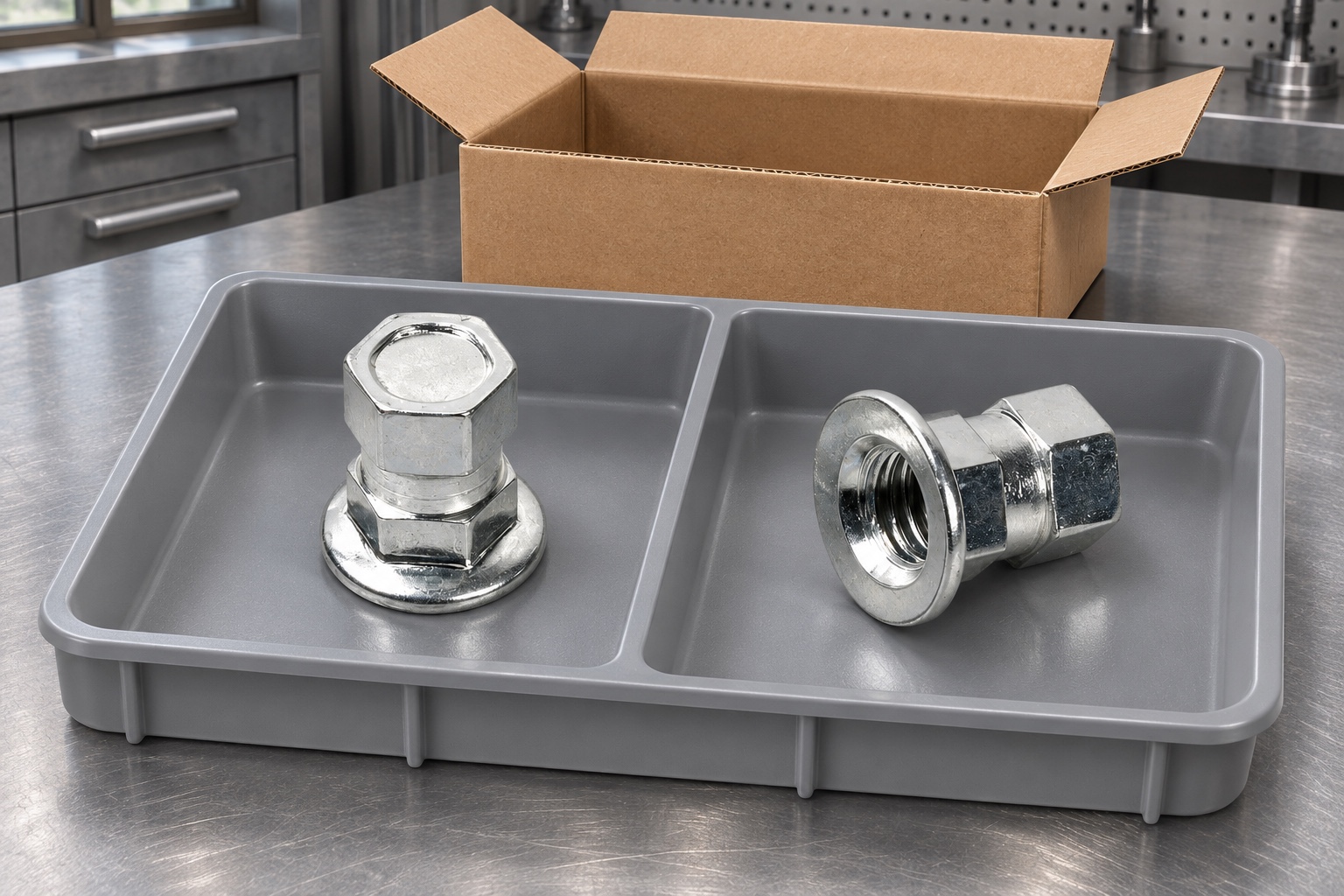
A sealed bag can prevent loss while still allowing nuts to strike and rub against one another. A divided tray can separate parts but fail to keep debris out if it is left uncovered. Identify which function each packaging element provides rather than treating a familiar container as a complete solution.
Review what happens when the pack is turned, lifted or transferred. Parts that remain separate on a horizontal bench may move into a different relationship during shipping. Include the closure and the way the inner pack is restrained inside the outer carton. The accepted arrangement should describe the complete package, not only an open tray photographed before its lid is fitted.
The Canadian Conservation Institute’s physical forces guidance explains general contact, impact and vibration damage mechanisms. Its subject is cultural objects, not qualification of industrial nuts. The limited transferable principle is to consider the item, its supports and its container together; it supplies no approved packaging dimensions for this TNHO reference.
Consider which neighboring surfaces can reach the opening. Another nut’s corner, a loose staple or a sharp container feature can create an unwanted contact route. The packaging design should prevent that route under the handling conditions represented by its evaluation, rather than rely on the parts remaining exactly as the packer placed them.
Do not insert an improvised screw into the thread as a protective plug. It may introduce an incorrect thread, unwanted residue or an unrecorded assembly history. If a purpose-designed protector is proposed, specify its compatibility, fit, cleanliness, attachment and removal requirements through the approved package design.
Also consider loose protective materials. A fragment of liner pushed into the opening is not an acceptable replacement for controlled protection. The method must leave the supplied thread in the required condition after unpacking, without relying on the receiver to discover and remove undocumented material.
The flange can be a functional contact surface in the finished joint. Define any permitted packaging contact and surface-condition requirements from the drawing. A support that keeps the thread entrance clear may still allow the flange face to rub against an abrasive or contaminated liner.
Avoid selecting contact materials solely because they feel soft. Their cleanliness, compatibility and movement against the part matter. A soft material carrying trapped particles can introduce a different problem. Where a liner, divider or formed pocket is used, identify the material and the condition in which it is acceptable for reuse.
Do not infer the required preservative from the silver appearance of the reference. The supplied finish and downstream application determine compatibility. Oil, inhibitor paper, adhesive or another treatment should be introduced only when approved for that exact delivery condition.
Follow the pack through dispatch, transport, receiving, stores and the assembly station. Identify where it is opened, divided or repacked. Original shipping protection may disappear when a carton is split into small picking quantities, even though the remaining stock retains its original supplier label.
The NASA fastener procurement and storage publication links fastener identity, receiving and storage within its mission-hardware scope. It does not certify these commercial nuts or select their shipping container. Use the general lesson to keep condition and identity controls connected through each transfer.
Specify who supplies the smaller containers, who checks their condition and how the nut identity follows the transfer. Keep unapproved line returns separate from unopened material until their identity and handling history have been reviewed. The receiving and return paths should be defined before a busy operator needs to improvise them.
This table organizes a review. It contains no universal transport limit or performance rating.
| Concern | Contact or contamination route | Control to define | Evidence after the agreed evaluation |
|---|---|---|---|
| Thread entrance damage | Other parts or hard pack features reach the opening | Separation and compatible support | Condition of the represented entrance features |
| Internal debris | Loose liner, open containers or transfer residue | Clean materials and a controlled closure | Required cleanliness observation or verification |
| Flange-face marking | Rubbing against supports or neighboring nuts | Approved contact arrangement | Surface condition against drawing requirements |
| Inner-pack movement | Tray or bag shifts inside the carton | Restraint of the complete inner pack | Pack condition and part separation |
| Lost identity | Partial issue or repacking removes the source label | Transferable configuration and lot record | Traceable remaining stock and issued quantity |
The checklist should name an owner for each unresolved item. A supplier can propose a packaging arrangement, but the customer must communicate the condition that matters at delivery. Neither party should have to guess which surface a cosmetic or functional restriction refers to.

Use the proposed quantity, materials, supports, closures and outer container together. A trial of one loose nut does not represent a full carton. Record the part revision and any substitutes so the evaluation’s scope remains clear.
Agree the handling or transport evaluation and acceptance criteria before the trial. Use the applicable customer or packaging specification; do not borrow an arbitrary drop height or vibration duration from an unrelated example. Identify the features and conditions to be checked afterward, including the thread entrance, flange face and required internal cleanliness.
Inspect the packaging as well as the parts. A damaged divider may explain how contact became possible even when the most visible nut appears unchanged. Conversely, an undamaged carton does not establish that the internal arrangement remained effective. Retain the observations with the actual tested configuration rather than describing a general packaging type as proven.
Provide an opening method that avoids cutting close to the parts or introducing loose packaging fragments. Identify how the nuts are removed from the inner arrangement and where they go next. The receiver should not need to shake an unidentified mixture of nuts and packing material onto an assembly bench.
If damage or contamination is found, retain the affected package, part identity and observations before discarding evidence. Keep the stock distinguishable while the responsible person determines the inspection scope and disposition. Do not force a production screw into a damaged entrance to decide whether the nut is acceptable.
An apparent thread concern requires the specified verification method. A packaging review cannot replace thread acceptance, and an acceptable thread check does not prove that every surface or delivery requirement has been met. Separate those decisions so a successful check does not conceal an unperformed one.
Review the storage and issue route alongside the shipping pack. The fastener storage guide covers general stock-area considerations. The smaller picking arrangement still needs to preserve the relevant thread and flange condition until assembly.
Do not confuse packaging contact with the contact required during installation. The flange nut socket envelope review addresses the tool route around the stepped exterior. A protective component must be removed or otherwise handled according to its approved instruction; it cannot silently become part of that installation arrangement.
Keep the accepted packaging configuration under review when quantity, liner, tray, supplier or route changes. A replacement carton or an additional row of nuts may change the available movement and contacts. Retain the reason for acceptance so the next purchasing decision can be checked against the same protection objective.
NPTEL IIT Guwahati’s “Lec 27: Material handling systems” provides educational context for material movement and transfer points. It supports reviewing the route around the package. It does not qualify a thread protector, liner or transport test for these nuts.

Not automatically. It can retain parts while allowing contact and movement. Review the complete arrangement against the thread entrance, flange and delivered-condition requirements.
Do not use an improvised mating part. Any protector requires an approved specification covering compatibility, cleanliness, fit and removal. Preserve the actual delivery condition and assembly history.
No. Inspect the inner arrangement and required part characteristics through the receiving procedure. Internal rubbing, debris or loss of separation may not be visible from the outside.
Review changes that can affect support, contact, movement or contamination. The earlier trial supports the configuration and conditions it represented, not every package carrying the same generic description.

 TNHO